




Understanding the Norwood Stage 7 Hair Loss Stage
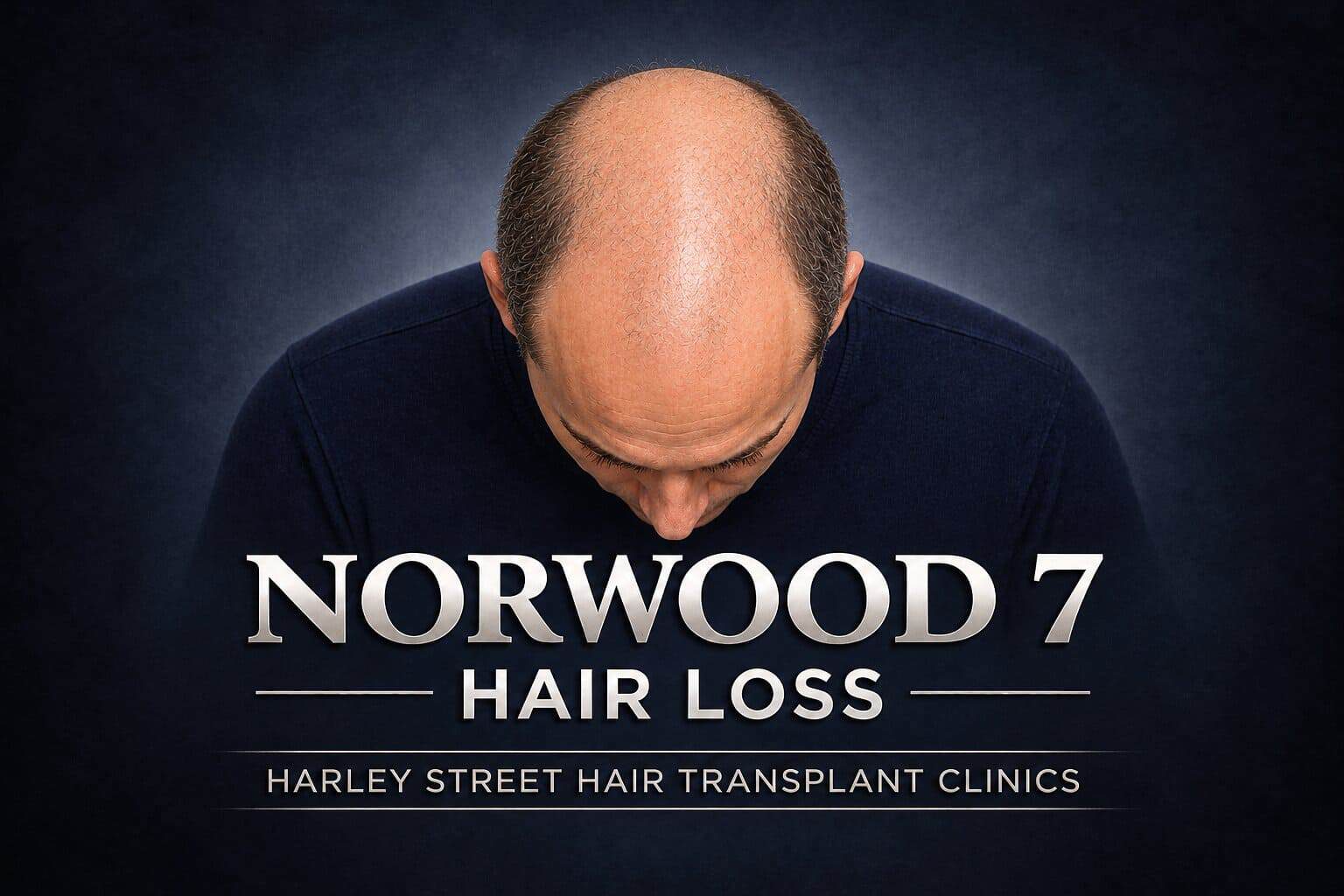
Norwood 7 hair loss stage represents the most advanced and aggressive stage on the male pattern baldness (androgenetic alopecia) Hamilton-Norwood Scale. At this stage, the hair across the entire top of the scalp, from the temples, frontal third, mid-scalp and crown, has suffered hair loss over the last years. The hair loss has continued to drop down the back of the scalp, the sides have moved down, and the nape has likely suffered retrograde alopecia, as a result leaving only a narrow band of hair around the back and sides of the head.
For a Norwood 7 hair loss sufferer, it can be important to understand the biological mechanisms, how the hair loss became so aggressive, and realistic cosmetic solutions.
Understanding the Hamilton-Norwood Scale
The initial hair loss category scale was developed by James Hamilton in the 1950s and updated by Dr. O’Tar Norwood in 1975. The Hamilton-Norwood Scale serves as the standard clinical reference to measure the progression of the male pattern baldness genetic hair loss condition, also known as androgenetic alopecia.
The Norwood scale tracks the progression of hair loss, from little to no hair loss, to the most advanced male pattern hair loss stage. It is categorised by Norwood (NW) then 1 to 7, one being minor to no hair loss, seven being the most aggressive hair loss pattern. Hair loss over the crown or vertex is denoted by a “V”, for instance NW3V.
- Stages 1 to 2: Minor hairline temporal recession or a matured hairline.
- Stage 3: The hairline apex has matured, and the temples opened, exposing a deeper recession, creating a distinct M or V shape.
- Stages 4 to 5: The hairline has receded over the frontal, hair loss likely over the crown, with partial thinning in the mid-scalp.
- Stage 6: Hair growth ceased over the top of the scalp, with hair loss starting to affect the back and sides.
- Stage 7: The final stage in the hair loss scale, leaving only a thin band of hair around the back and sides of the head.
While most men will experience male pattern hair loss during adulthood, only a small percentage will advance to a Norwood 7 aggressive hair loss pattern. To reach this stage of thinning has meant a strong genetic trait of vulnerability to the male pattern hair loss gene.
The Norwood 7 Hair Loss Pattern Appearance
The look of the Norwood 7 hair loss pattern is unmistakable due to the narrow band of hair surrounded by a much larger hairless area. Not only because hair loss has spread from the temples to the crown, but the hair boundary has receded downwards to the sides and back of the head.
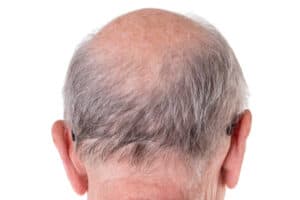 The horseshoe pattern has a low perimeter boundary situated at the lower scalp. Then the lateral borders drop down the sides closer to the ear, with the posterior hair boundary dropping down the back of the head towards the occipital area. It is common with this level of hair loss, Norwood 7, that the remaining hair within the horseshoe is affected by secondary thinning, and typically has signs of a reduced hair density, finer hair calibre, and a slower growth rate.
The Biological Causes Resulting in a Norwood 7 Hair Loss Stage: DHT
The fundamental driver of genetic male pattern hair loss, androgenetic alopecia, at the Norwood 7 stage is a sensitivity to androgenic hormones, specifically Dihydrotestosterone (DHT). DHT is a byproduct of testosterone, formed when testosterone combines with an active enzyme, 5-alpha reductase.
Those individuals with a genetic predisposition to severe hair loss inherit this trait from family members from both the maternal and paternal gene pools. The hair follicles generally over the top of the scalp possess an overabundance of androgen receptors, meaning the hair follicles carry the male pattern hair loss gene. When DHT binds to these hair follicles, and more so to the receptors, a cascading effect is triggered, known as follicular miniaturisation.
The hair growth cycle is interrupted, with the anagen or growth phase reducing in length, resulting in a drop of hair actively growing on the scalp. As the anagen phase reduces, the sleeping stage, or telogen phase, becomes longer, meaning the hair follicle is not generating a new hair. Over time the anagen phase becomes shorter, and the hair follicle generates slower, finer, and shorter hair shafts. The area of hair loss becomes larger as the hair follicles atrophy away from the vital blood supply until they eventually detach and cease hair reproduction.
The Norwood 7 band of hair around the back and sides remains largely intact, as these hair follicles do not carry the androgen receptors, or the male pattern hair loss gene. As a result, DHT cannot bind to them.
Norwood 7 Hair Restoration Challenges
In the field of hair restoration there is a fundamental requirement, that the donor supply can satisfy the recipient area demand. At the Norwood 7 hair loss stage the ratio of hair to baldness is vastly in the favour of baldness. The heavily unbalanced contrast between the size of the recipient area compared to the small donor area, along with biological restrictions, means total hair restoration is impossible with a surgical hair transplant procedure.
The Hair Transplant Problem
A hair transplant, Follicular Unit Extraction (FUE) or Follicular Unit Transplantation (FUT), is best suited to Norwood 5 and below hair loss stages. Even Norwood 5 can be a challenge if the hair characteristics are below average. However, a hair transplant, regardless of the technique, is at best going to achieve a limited result. A Norwood 7 considering a hair transplant must understand all the limitations to undergoing a surgical hair restoration procedure, issues such as:
- Insufficient Donor: the narrow strip of donor hair simply limits the amount of hair that can be harvested while safely removing healthy donor hair follicles. As a result, the hair coverage achieved over the recipient is limited.
- Weak Donor Hair Quality: it is common with a Norwood 7 hair loss stage that the donor may contain a higher percentage of miniaturised hairs, and these cannot be used, further limiting the donor resource.
- Over-harvesting Risk: attempting to extract too many grafts from a narrow horseshoe band will leave the donor with an obviously thinner hair density with FUE, and possibly a visible linear scar with the FUT technique.
- Minimal Hair Coverage: rebuilding such a small region of the recipient area can draw more attention to the untreated areas, especially if it is impossible to join the recipient and donor areas because the laterals have dropped too far. As a result, the doctor is required to carefully plan the hair restoration to ensure a natural aesthetic is achieved.
Approach to a Hair Transplant and Norwood 7
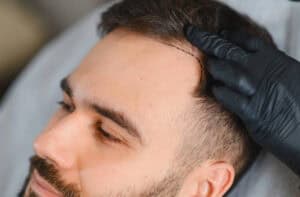 Despite the challenges, a hair transplant is not entirely impossible for a Norwood 7 patient. However, it requires expert planning and understanding to achieve hair coverage which will be limited but look natural, and at the same time educate the patient to ensure they have realistic expectations.
- Rebuilding the Frontal Third: an experienced, proficient doctor will not spread the hair over the entire surface of hair loss. Rather, they focus on one area, the frontal region, and rebuild a mature frontal hairline and a light mid-scalp frame. This frames the face naturally while leaving the crown intentionally untreated.
- Using Body Hair (BHT): if the body hair is plentiful and the hair characteristics are close enough to the scalp hair, it is a viable added donor resource. To expand the donor pool, it is possible to harvest hair follicles from alternative regions, such as the beard, chest, or abdomen. Beard hair is thicker and serves as an excellent filler when mixed among traditional scalp grafts.
- A Combined Surgery, FUT and FUE Techniques: using a strip surgery Follicular Unit Transplant (FUT) alongside the individual extraction harvesting of Follicular Unit Extraction (FUE), especially if using body hair as a filler, will allow the doctor to maximise the graft count in a single procedure.
Non-Surgical Solutions
Because a hair transplant result will be so limited, if the individual wants total hair coverage, or at least the appearance of the same, a non-surgical option may be the answer.
Scalp Micropigmentation (SMP)
Scalp Micropigmentation is a non-surgical cosmetic treatment that mimics the appearance of shaved hairs. Often described as a medical hair tattoo, an ultra-fine micro-needle deposits carbon-based pigments into the upper dermal layer of the scalp. Unlike a traditional tattoo, SMP only uses one tone, no colours.
Applying thousands of tiny dots over the area of hair loss can mimic the look of a shaved head of hair, even on a Norwood 7 hair loss stage. Care must be taken to ensure the SMP technician understands how to design a natural hairline that correctly frames the face.
Any remaining native hair must be kept shaved, otherwise the illusion is lost. Typically completed over two to three sessions spaced weeks apart, this layered approach allows the skin to heal and the density to build gradually for a seamless, natural finish. The pigment will fade over time and need touch-up sessions every one to three years.
Hair Systems
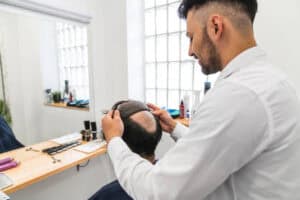 A hair replacement system is designed to restore a full head of hair instantly. They use either synthetic or human hair woven or implanted into a synthetic base, which is custom made to the individual’s scalp size and preferred hairline design. The bases generally fall into two types, an open microfilament, or a closed polyurethane.
The base is secured to the scalp using a medical-grade adhesive, although tapes and clips can be used if the system needs to be removed daily. The adhesive means it will remain secure for around four weeks, until the hair grows and the system becomes loose. Routine maintenance is required and they will need replacing over time.
Questions & Answers
Medical treatments such as Finasteride (a DHT blocker) and Minoxidil (a vasodilator) are effective at slowing down hair loss or regrowing hair during Stages 2 through 5. However, at Norwood Stage 7, medications are ineffective. Once a hair follicle has completely miniaturised, no treatment can resurrect it.
No, it is technically impossible to achieve a full density head of hair with a hair transplant. Simply, the donor cannot provide enough hair to restore such a large area of hair loss.
Yes, SMP is widely considered one of the most effective and low-maintenance options for Norwood 7 patients. Since there is no longer a natural hairline or top coverage, an SMP technician can design a completely new hairline and continue with the pigments across the entire top of the scalp. In the hands of a proficient SMP technician, this can create a realistic illusion of a full, dense head of hair that has been cleanly shaved.
To attempt a full restoration across the entire scalp, it would require in the region of 9,000 to 10,000 grafts. However, a Norwood 7 scalp donor cannot get anywhere close to these numbers. Even an average donor on a lower Norwood stage cannot reach close to these numbers, not without over-harvesting. A Norwood 7 scalp donor may yield 2,000 to 4,000 grafts with careful donor management.