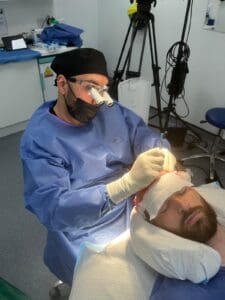






A body hair transplant refers to a specific form of Follicular Unit Extraction (FUE) where donor hair is taken from the body (usually from the beard or chest) instead of the back of the head. It is typically reserved for complex cases where scalp donor hair is limited or depleted. Body hair grafts are very rarely a first-line treatment. It is a specialised solution for patients who require additional grafts to improve density, repair previous surgery, or restore advanced hair loss.
What is a Body Hair Transplant?
 A body hair transplant (BHT) is a rare and useful method of hair restoration surgery involving the extraction of hair follicles from areas such as the beard or chest and implanting them into the scalp. While the usual donor area (back and sides of the head) is used for 99% of cases, body hair can be used in complex surgical cases where traditional donor hair is severely limited.
In most instances, body hair is used after a patient has already had two or three previous surgeries and still requires an increase in density. Particularly in the crown and bridge sections of the scalp. Body hair is never used in hairlines. This is because hair from the chest and beard behaves differently from scalp hair. It has different growth cycles, calibre, and texture. For this reason, BHT is usually used to improve density rather than recreate a natural hairline.
In 2026, advanced FUE or DHI techniques are primarily used in London for body hair transplantation. At our Harley Street clinic, the procedure is usually performed using Follicular Unit Extraction (FUE). Individual grafts are removed from the body donor area and implanted into thinning or bald areas of the scalp. During an FUE body hair transplant, a micro punch tool (between 0.7 and 0.85mm) is used to extract hair follicles, meaning there is no visible scarring to the donor area after surgery.
Body Hair Transplant vs Scalp Hair Transplant Procedure: The Key Differences
A traditional scalp hair transplant uses donor hair from the back and sides of the head. These areas are genetically resistant to hair loss. Comparatively, a body hair transplant uses non-scalp donor sources. The most common is beard hair. Chest hair may also be used in selected cases.
Key differences between the two methods include:
- Growth cycle duration – body hair grows shorter and has a different growth cycle compared to scalp hair, which can affect the final aesthetic results.
- Extraction time during surgery – the extraction of body hair grafts is more time-consuming and requires a higher degree of skill than traditional scalp FUE.
- Curl pattern – body hair often has a different curl pattern compared to scalp hair. Beard hair may be coarser and slightly wiry. Chest hair can be finer and curlier.
- Graft survival rates – scalp donor hair generally has higher and more predictable survival rates. Body hair graft survival can vary depending on donor source, extraction technique, and placement strategy.
- Overall density potential – Scalp hair provides the highest density potential in hair transplantation. Body hair is usually used to supplement density rather than create it from scratch.
Scalp donor hair remains the gold standard. Body hair is considered a supplementary resource when scalp donor supply is insufficient.
How Does a Body Hair Transplant Procedure Work?
The procedure follows the same core principles as FUE surgery. An FUE hair transplant procedure is split into three stages: donor hair extraction, recipient site incisions, and graft implantation. A body hair transplant is performed by a GMC-registered surgeon with the assistance of expert technicians in a CQC-registered clinic.
Because body hair behaves differently from scalp hair, surgical planning is more detailed. Donor selection, graft handling, and placement strategy are critical to achieving natural results. So, be sure to choose a surgeon-led clinic who specialise in body hair transplant procedures.
The entire body hair transplant procedure typically lasts 4 to 8 hours, depending on the number of grafts harvested and implanted. All body hair transplants are performed under local anaesthesia, minimising any chance of pain during the procedure. So, how does the procedure work?
 The donor area is first trimmed and sterilised. Local anaesthetic is administered to ensure patient comfort. Individual follicular units are extracted using a precision micro punch, typically between 0.7 mm and 0.9 mm in diameter.
Body hair follicles often sit at sharper angles beneath the skin compared to scalp hair. This increases the technical difficulty of extraction and requires careful control to minimise graft damage. During a body hair transplant, the surgeon performs extractions while technicians count harvested grafts.
Beard hair is frequently preferred. It has a thicker calibre and stronger follicular structure, making it well suited for improving density in the mid scalp and crown. Chest hair may also be used in selected cases, although it is generally finer and provides softer coverage.
Once the grafts are prepared, recipient sites are created within the thinning or bald areas of the scalp. This stage determines the final aesthetic outcome. The surgeon carefully controls the angle, depth, and direction of each incision to ensure natural growth patterns.
Hairline work typically relies on scalp donor hair. Body hair is rarely used at the frontal hairline due to differences in texture and growth characteristics. In almost all instances of body hair transplants, incisions are made into the crown/bridge area.
The grafts are then implanted into the recipient sites. This part of the procedure is performed by technicians under the watchful eye of the surgeon. Each follicular unit is placed with precision to maintain correct angulation and density distribution. Proper handling during this stage is essential to maximise graft survival.
Because body hair differs in calibre, curl, and growth cycle, placement must be deliberate. Beard grafts are commonly used to reinforce density in structurally important areas.
Over the following months, the transplanted hairs shed before entering a new growth phase. Visible regrowth typically begins around three to four months, with continued improvement up to 12 to 18 months.
When is Body Hair Used for Hair Transplant Surgery?
 Body hair is used for a hair transplant when there is an insufficient number of viable grafts in the traditional donor area to support a surgery. It is incredibly rare for body hair to be considered unless a patient is a Stage 6 or 7 on the Hamilton-Norwood Scale.
A traditional scalp hair transplant uses donor hair from the back and sides of the head. These areas are genetically resistant to hair loss. A traditional donor area on the back of a patient’s head holds anywhere between 12,000 and 15,000 hair follicles. That’s around 6,000 grafts that can be harvested before the back and sides of the head will begin to look visibly thinner than a non-transplanted donor area.
With this in mind, a body hair transplant is typically considered in the following situations:
- Advanced hair loss with limited scalp donor supply
- Previous hair transplant surgery that depleted donor reserves
- Repair cases requiring additional grafts
- Patients seeking increased density in specific areas
It is not appropriate for every patient. Additionally, most hair transplant surgeons and clinics do not perform complex repair work. So, an in-person consultation and donor assessment is always required before recommending this approach. Be sure to choose a reputable, surgeon-led clinic.
Is Body Hair Transplantation Permanent?
Yes, transplanted body hair is permanent once it successfully establishes blood supply in the scalp. In this regard, it is the same as traditional donor hair follicles. Both types of donor hair follicles are resistant to DHT-related hair loss.
However, it retains many of its original characteristics. Beard hair may remain thicker. Chest hair may grow shorter and have a different growth cycle compared to scalp hair. So, while body hair provides the option of increased density, it comes with the trade off of
Results are long term, but expectations must be realistic. Body hair enhances coverage and density rather than perfectly replicating native scalp hair.
Who is a Suitable Candidate for a Body Hair Transplant?
Suitable candidates for a body hair transplant procedure usually have experienced significant scalp donor area depletion. Men with advanced androgenetic alopecia often benefit most from BHT.
Among all body donor sources, beard hair offers the highest stability and survival rate, making it the preferred option in most cases. Eligible patients will need to have coarse beard hair with good density.
Most modern clinics in London use precision tools to match the angulation and depth of existing scalp hair during BHT. Every effort is made to achieve a natural looking final result. However, it is important to remember that body hair transplants have significantly lower success rates due to differences in hair growth cycles and characteristics compared to scalp hair.
Beard Hair vs Chest Hair: Which is Better for Body Hair Transplantation?
Beard hair is generally a superior choice to chest hair. This is because beard hair has a thicker shaft and stronger growth characteristics. This makes it effective for increasing density in the mid-scalp and crown.
Chest hair is softer and thinner. It may be used for blending or softening areas, but it provides less structural density. Due to this, chest hair is more often used as a blending agent. Mixing body hairs from different sources like beard, chest, and extremities helps to achieve a blended natural look when transplanting to completely bald areas on the scalp.
In most complex hair restoration cases, beard-to-scalp transplantation produces more reliable results than chest hair transplantation.
What Results Can You Expect From a Body Hair Transplant?
Results develop gradually. The growth timeline for body hair transplants is similar to standard FUE, although body hair may mature slightly more slowly.
Initial shedding occurs within the first few weeks. New growth typically begins around three to four months. Patients can expect to see shedding of transplanted hair within the first 0 to 3 months after the procedure. Visible improvement continues over 12 (for hairlines) to 18 (for crowns) months.
Density improvements depend on each patient’s donor hair quality, the number of grafts transplanted, and the surgical team’s placement strategy. Body hair is most effective when used to complement scalp grafts. It is rarely a standalone solution for full coverage.
Risks and Limitations of Body Hair Transplants
Body hair transplantation is more technically demanding than standard FUE. It requires a hair transplant surgeon and team of technicians that are specially trained in body hair extraction. When performed properly, a body hair transplant procedure can provide visual improvements in hair density.
Higher transection rates are observed while harvesting body hair compared to scalp hair, which can affect graft yield. However, overall success rates of body hair transplants range between 50% and 80%.
Potential limitations of BHT include:
- Lower graft survival compared to scalp hair
- Different texture and growth patterns
- Visible contrast if poorly placed
- Limited donor availability
Choosing an experienced hair transplant surgeon is essential for achieving natural results. At Harley Street Hair Transplant Clinics, we’re recognised for our expertise in BHT procedures.
Body Hair Transplant FAQs
Technically, it is possible. In practice, it is rarely recommended. Pubic hair has a markedly different texture and growth pattern. This makes it unsuitable for visible scalp areas.
Body hair continues to grow after transplantation. However, it often retains its original growth cycle. Some body hair grows to a shorter maximum length compared to scalp hair.
The procedure is performed under local anaesthetic. Patients may experience mild discomfort during recovery, particularly in beard donor areas. Most discomfort resolves within a few days.
This varies depending on beard density and skin characteristics. In selected patients, several hundred to over one thousand grafts may be safely extracted over multiple sessions.
Yes. Body hair can significantly improve perceived density, especially in the mid-scalp and crown. It is most effective when combined with scalp donor hair as part of a comprehensive hair restoration plan.