




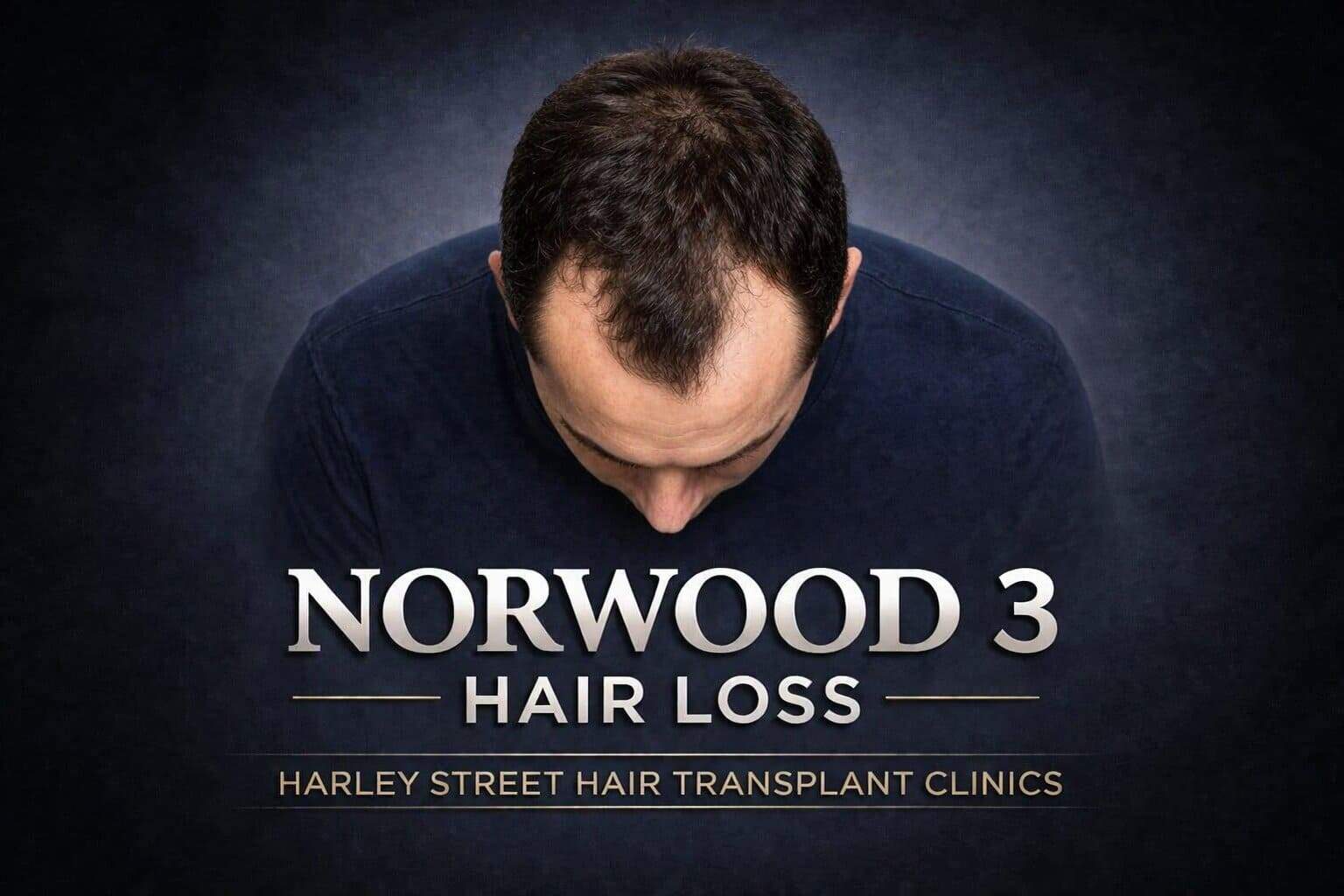
Norwood 3 hair loss marks one of the early stages of male pattern baldness (androgenetic alopecia). It’s commonly treated with medication and/or a hair transplant. But here’s the thing: Norwood Stage 3 is one of the most misunderstood stages of hair loss, and rushing into surgical decisions at this point can lead to poor long-term outcomes.
In this guide, we’ll break down exactly what Norwood Stage 3 means, what it looks like, whether a hair transplant makes sense, and what kind of results are realistically achievable through the lens of long-term planning rather than short-term cosmetic fixes.
What Is Norwood Stage 3?
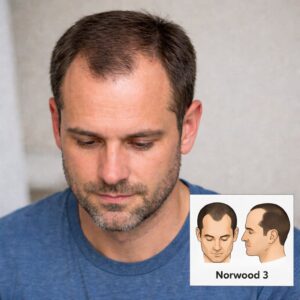 The Norwood-Hamilton Scale is the most widely used classification system for male pattern baldness. Norwood Stage 3 represents the first stage considered true clinical hair loss. Norwood Stage 3 is often the point where male pattern hair loss stops being subtle and starts to feel clinically undeniable. The hairline recession is no longer something you can explain away with styling choices or lighting. It’s measurable, diagnosable, and progressive.
At Stage 3, the prominence of a frontal tuft is observed, where hair is retained in the centre of the forehead despite recession at the temples, forming a deeper “M-shaped hairline“. The central forelock may still be intact, but the corners have moved far enough back that the change is obvious to the sufferer.
For many men, this is also the stage where the idea of a hair transplant first becomes seriously considered. A hair transplant surgery to tackle a receding hairline, usually FUE or DHI in these circumstances, usually requires anywhere between 1,200-1,800 grafts.
Key Characteristics of Norwood Stage 3
- Noticeable recession at both temples
- A defined M- or V-shaped hairline
- Central hairline largely preserved
- No significant crown thinning (in most cases)
- Hair loss is typically androgen-driven and progressive
This is the point where hair loss stops being theoretical and becomes structural. What’s even worse is that Norwood stage 3 can appear at any age. It doesn’t just affect men in their 40s and 50s.
A receding hairline visibly alters the appearance and proportion of your face. So, that is why many men choose to act. In so many cases, early intervention yields the best results.
Norwood Stage 3 vs Mature Hairline
One of the most common and costly mistakes men make is confusing Norwood Stage 3 hair loss with a mature hairline. So, let’s outline the difference.
A mature hairline typically recedes slightly (1–1.5 cm), stabilises, and does not continue to thin aggressively. Norwood Stage 3, on the other hand, shows deeper temporal recession, hair loss extending beyond the juvenile hairline zone, and ongoing miniaturisation under magnification.
If recession is still advancing, especially asymmetrically, it is not a mature hairline; it’s Norwood Stage 3. That’s the difference between hair loss and a mature hairline.
Is Norwood Stage 3 Considered Early Hair Loss?
Clinically speaking, yes. Norwood 3 does mark the early stages of hereditary hair loss. But strategically, it’s a critical stage. At this stage, a sufferer will not be experiencing crown hair loss, making medical/surgical intervention much easier.
Norwood Stage 3 is early enough that:
- Medical therapy can still be highly effective – you may have heard of hair loss medications like finasteride and minoxidil.
- Donor supply remains untouched – if you combat Norwood 3 hair loss early, you may not need a hair transplant. This means no hair follicles from your donor area need to be used as part of a surgical procedure.
- Long-term planning has the greatest impact – being strategic in your efforts to combat hair loss means you’re setting yourself up for success. Opting for preventative therapies (e.g. medication, PRP) in your 20s and 30s means you are less likely to require a second hair transplant in the future, saving you thousands of pounds in the long run.
But it’s also advanced enough that:
- Cosmetic changes are obvious – having a hair transplant directly reverses those signs of a receding hairline. You’re making a concerted effort to reframe the aesthetics of your face.
- Psychological distress often increases – many men choose to treat Norwood 3 hair loss to improve their appearance and self-confidence.
- Poor decisions made now can permanently compromise future options – in many ways, not doing anything can be the worst call. By not implementing a treatment plan, you are increasing the chances of your pattern baldness progressing.
This is the fork-in-the-road stage of male pattern baldness. With this in mind, let’s dive deeper into the progression of male pattern baldness and what you can do to stabilise and reverse pattern hair loss.
Can Norwood Stage 3 Progress Further?
Yes. In clinical practice, Norwood Stage 3 almost always progresses if left untreated. That’s because Norwood stage 3 hair loss primarily stems from androgenetic alopecia, which is influenced by genetics and hormones. So, many men choose to treat male pattern baldness with medication or a hair transplant.
Norwood Stage 3 represents a significant turning point in male pattern hair loss. At this stage, recession at the temples becomes clearly established and is no longer considered a “mature hairline.” While some patients hope hair loss will stabilise at this point, long-term observation shows that Norwood Stage 3 is typically an early indicator of ongoing androgenetic alopecia rather than its endpoint.
Without medical intervention, Norwood Stage 3 frequently progresses to Norwood Stage 4, where temple recession deepens and thinning at the crown becomes apparent. This is where many men begin to notice significant hair loss.
Over time, this may advance further into Norwood Stages 5 and 6, characterised by expansion of frontal and crown hair loss and eventual merging of these areas. Once this progression occurs, treatment options become more limited and surgical planning more complex. That’s why it’s important to treat hair loss early.
The rate at which Norwood Stage 3 progresses varies between individuals, but it is influenced by several factors. These include genetic predisposition, age of onset, and the individual’s sensitivity to dihydrotestosterone (DHT). Importantly, the presence or absence of evidence-based medical treatment plays a decisive role in determining whether hair loss stabilises or continues to advance.
One of the most damaging assumptions we see in our clinic is the belief that hair loss will naturally stop at Norwood Stage 3. In reality, untreated progression is far more common than long-term stability. Early assessment and appropriate medical management are essential for preserving existing hair and maintaining future treatment options.
Norwood Stage 3 Treatment Options
Medical Treatment (First-Line)
For most men at Norwood Stage 3, medical therapy should be the foundation, not an afterthought. Common options to promote hair regrowth include:
- Finasteride (oral or topical)
- Minoxidil (topical or oral)
- Ketoconazole shampoo (adjunctive)
When started early, these treatments can:
- Slow or halt progression
- Improve hair calibre
- Preserve existing density

The best medical approach is often combined minoxidil and finasteride use. Finasteride helps prevent DHT from binding to androgen receptors on the scalp, preventing thinning hair. In addition, Minoxidil helps to increase hair density, making your hair follicles appear thicker and fuller.
In many cases, medical therapy alone can stabilise Norwood Stage 3 sufficiently to delay (or completely avoid) surgery. Oral finasteride may induce side effects in a small number of patients with a receding hairline, so it’s important to speak with a hair transplant surgeon or trichologist before starting any medication.
Hair Transplant for Norwood Stage 3
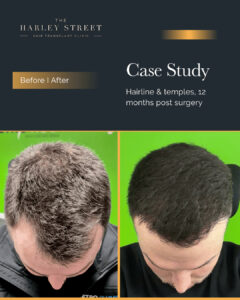 Norwood Stage 3 can be also be treated with a hair transplant. Hair transplants are often considered a permanent solution for Norwood stage 3 hair loss, as they involve transplanting healthy hair follicles to balding areas.
If you don’t know whether surgery is the right option for you, ask yourself the following question: do you want to stop further hair loss or restore hair in an area where hair follicles have already miniaturised?
A transplant at this stage is typically focused on:
- Rebuilding the temples
- Softening the M-shape
- Restoring frontal framing
However, this is where ethical planning matters most. Transplanting aggressively into a Norwood Stage 3 hairline without controlling future loss can result in:
- An unnaturally low hairline
- Isolated transplanted zones
- Depleted donor supply
- A cosmetic disaster by Norwood 5 or 6
A conservative approach is non-negotiable. All of our hair transplant surgeons will recommend taking prescription medication to prevent further thinning in patients aged 25-45. Think about it this way, if you’re spending between £5,000 and £8,000 to look your best, you’ll want to do everything to maintain your appearance for many years to come.
Ideal Hairline Design for Norwood Stage 3
The best hairline design for a Norwood Stage 3 patient is one that is conservative, age-appropriate, and strategically planned with future hair loss in mind. At Harley Street Hair Transplant Clinics, the goal is not to recreate a juvenile hairline, but to restore balance and frame the face while preserving donor hair for potential future procedures.
At Norwood Stage 3, recession is most pronounced at the temples, often creating an “M-shaped” hairline. An effective design typically focuses on softening this recession rather than aggressively lowering the entire frontal hairline. Attempting to restore a low, straight hairline may look unnatural over time and can rapidly exhaust valuable donor grafts.
A well-designed hairline should follow the patient’s natural facial anatomy and existing hair characteristics. This includes respecting natural temple angles, incorporating slight irregularities rather than sharp, artificial lines, and positioning the hairline at a height that remains appropriate as the patient ages. Density should be planned carefully, prioritising visual coverage rather than maximal graft packing.
Future progression is also a critical consideration here. Because Norwood Stage 3 often advances, hairline design must anticipate potential frontal and mid-scalp loss. That’s why we specialise in long-term hair restoration planning, providing medication to prevent further hair shedding.
How Many Grafts Are Needed for Norwood Stage 3?
While every case differs, the number of grafts needed for Norwood stage 3 hair loss typically ranges from 500 to 1,800 grafts.
- 500–1,500 grafts for mild recession (this would be a small temple hair transplant)
- 1,500–2,000 grafts for more pronounced temple loss (this would be a typical hairline hair transplant, potentially including lowering)
Another factor to consider is hair transplant method. A Follicular Unit Excision (FUE) hair transplant is usually the preferred solution for Norwood stage 3 hair loss. However, Direct Hair Implantation (DHI) is also a great option.
Norwood Stage 3 Hair Transplant Results: What’s Realistic?
 When done correctly, results can look natural, age-appropriate, and undetectable The best Norwood Stage 3 results are the ones that don’t announce themselves. If you don’t believe us, take a look at some of our before and after pictures:
Final Thoughts on Norwood Stage 3
Norwood Stage 3 is not the point at which hair loss becomes inevitable; it is the point at which outcomes are determined. At this stage, patients still have meaningful control over how their hair loss progresses, how natural their appearance remains, and how many options they retain in the future.
When managed correctly, Norwood Stage 3 allows for stabilisation through medical therapy, thoughtful surgical planning where appropriate, and preservation of the donor area for the long term. When managed poorly (or if you ignore it altogether), it is often the stage at which irreversible mistakes are made, from aggressive hairline design to unnecessary depletion of donor supply.
The key principle is simple: Norwood Stage 3 demands restraint, strategy, and long-term thinking. Whether treatment involves medication, a hair transplant, or a combination of both, every decision should be guided by future progression, not short-term cosmetic pressure.
Early assessment by an experienced clinic like Harley Street, evidence-based treatment, and conservative planning remain the most reliable way to protect both your hair and your options. So, why not book a free consultation today with one of our expert patient advisors?