





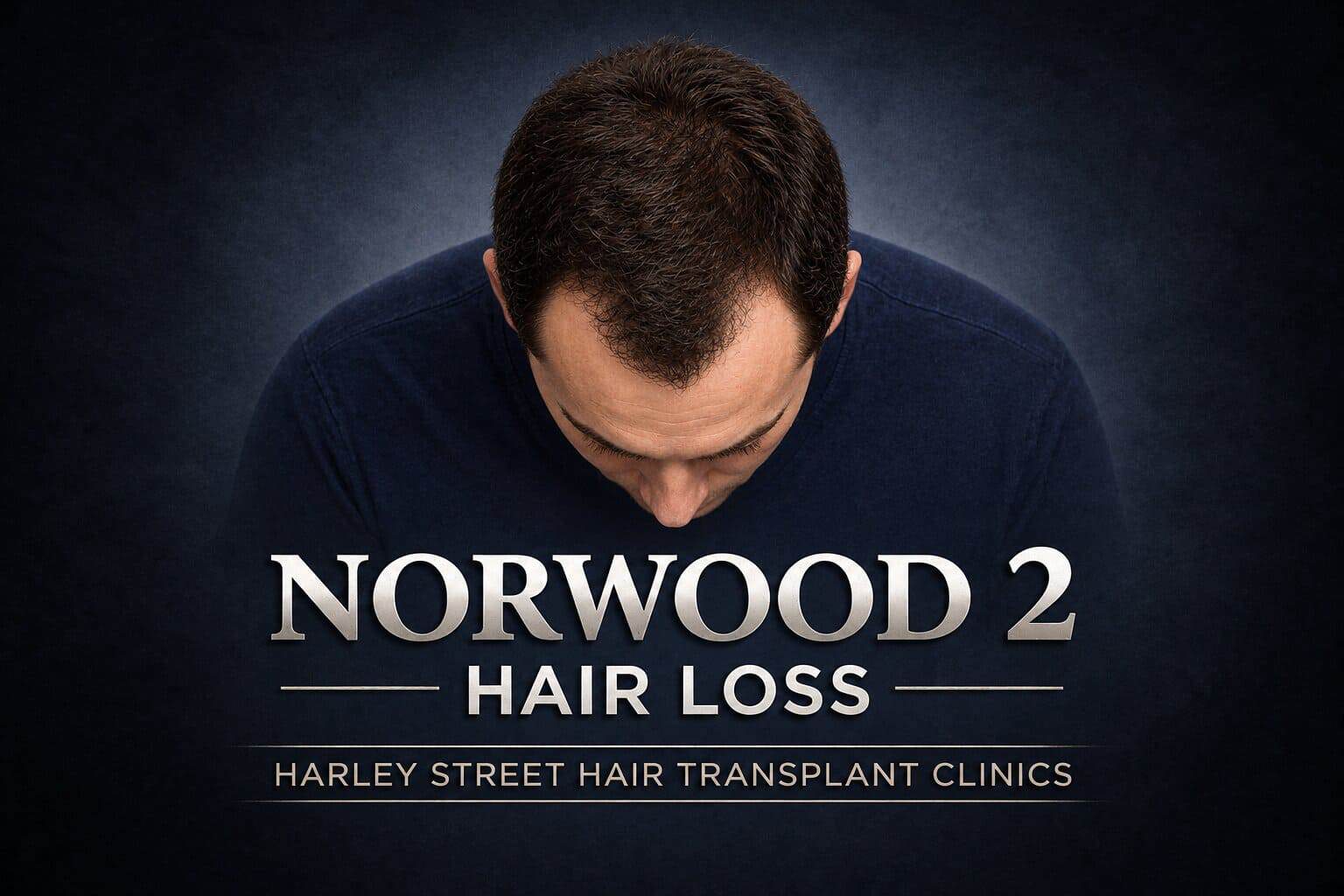
The Norwood 2 stage is at one end of the hair loss scale, also referenced as a “maturing hairline” stage. Norwood refers to Dr. O’Tar Norwood, the doctor who expanded on the original Hamilton Scale. Norwood examined one thousand men, opposed to Dr. James Hamilton´s earlier category examining only three hundred men. Norwood also added the crown, or vertex to the scale. The scale is used by anyone from a Dermatologist, Trichologist to Surgical Hair Restoration specialists to classify the current hair loss pattern and demonstrate how the pattern can progress.
What is the Norwood 2 Hair Loss Pattern Class
 The Norwood 2 category denotes the initial signs of a hair loss pattern caused by androgenic alopecia, or male pattern baldness. If hair loss can be stabilised at the Norwood 2 hair loss pattern stage, the individual will maintain a solid head of hair and avoid the potential of a surgical procedure.
The Norwood 2 stage is at one end of the hair loss scale, denoting the preliminary stages of hair loss. Only Norwood 1 stage is a lower hair growth pattern, indicating no visible recession. Opposed to Norwood 7 at the other end of the scale, a pattern resulting with only a thin band of hair around the back and sides of the head remaining.
Typical Norwood 2 Characteristics
 At Stage 2, the hairline has slightly receded in each temple, while it may appear symmetrical, there will be subtle differences that are not always visually apparent.
The hairline and temples move back, anything from millimetres to about one centimetre, creating a minimally defined “M,” shape across the immediate hairline and forehead.
The central apex, or midway point of the hairline remains low with a minimum upward angle to the temporal point. The immediate hairline remains strong, and the hairline is commonly dense and defined.
Unlike more advanced stages, Norwood 2, the is unlikely to be any significant thinning over any area of the head of hair, including the crown. With the frontal and mid-scalp remaining intact , healthy, and fully covered.
The Cause of Norwood 2
Most men have a predisposition to hair loss, the pattern or extent of hair loss largely indicated by the male pattern baldness gene being inherited from either the maternal or paternal sides.
The male hormone testosterone, combines with an active enzyme in the body called 5-Alpha Reductase, resulting in the production of Dihydrotestosterone (DHT). Dihydrotestosterone connects with the hair follicles that carry the hair loss gene, triggering the start of male pattern baldness. The hair growth cycle is interrupted, with the sleeping stage becoming longer, resulting in the growth stage becoming shorter. This affects the quality and speed of hair growth as the hair follicles atrophy, the hair shaft becomes finer and miniaturised, accompanied by stunted hair growth. Eventually, the hair follicles stop producing hair causing the hairline to recede.
Medical Treatments
The Norwood 2 stage is the ideal point to consider starting a medication to preserve and improve the hair growth, preventing a recession becoming deeper , and potentially reversing the process of miniaturisation. The two notably and extensively tested treatments for male pattern baldness are minoxidil 5% and Finasteride 1mg, topical and oral treatments, respectively. With additional options of both treatments now available.
Finasteride (Oral or Topical)
Finasteride is a recognised hair loss medication in topical or oral form, which addresses the cause of male pattern hair loss.
This prescriptive treatment blocks active enzyme 5-alpha reductase inhibitor, as a result, lowers the production of DHT in the body, this can reduce the levels of DHT by 70% and more, helping to preserve and potentially improve the hair growth.
Clinical data has shown that Finasteride dose of 1mg, taken orally halts hair loss progression in approximately 85% to 90% of men. About 65% of individuals experience measurable regrowth or thickening of thinning hairs.
Finasteride must first build a resistance in the body, as a result may take six to twelve months constant use before actively improving the hair growth.
A small percentage of users (typically 1–2%) may experience sexual side effects, including erectile dysfunction or loss of libido. Always discuss with a medical professional prior to starting any treatment.
Minoxidil (Topical or Oral)
Minoxidil, once prescriptive, is now available off the shelf in chemists and pharmacies. It acts as a vasodilator, meaning it dilates the blood vessels over the top of the scalp, acting as a growth stimulant.
By widening the blood vessels around the hair follicles, it allows for improved blood flow, oxygen, and nutrients to be delivered to the potentially weakening hair follicles. This lengthens the anagen or growth phase of the hair growth cycles, stimulating prematurely dormant follicles back into the growth phase and potentially improving the hair quality at the same time. Meaning there is actively more hair back growing on the head.
To treat male pattern baldness the recommended strength and dose is 5% minoxidil solution in lotion or foam form, applied daily to the scalp, am/pm. Low-dose oral minoxidil (ranging from 1.25 mg to 5 mg daily) is also used as an alternative for those with issues applying it topically.
As Finasteride and Minoxidil have quite different working mechanism it is possible to use a combination of both. As a result, tackling male pattern baldness from two distinct angles. Treating a Norwood 2 hair loss pattern with a medical treatment is arguable the best option, as medication can potentially halt further hair loss and obvious signs of thinning for coming years, of course individuals react differently and it´s impossible to guarantee a specific result.
Non-Surgical Therapies
The two popular credible alternatives to medical based treatment are a Plasma based therapy, called Platelet Rich Plasma and Low-Level Laser Therapy to treat a Norwood 2 hair loss pattern. These treatments offer an alternative to Finasteride and Minoxidil or can be combined to complete a comprehensive hair loss treatment regime.
Platelet-Rich Plasma (PRP) Therapy
PRP treatment uses a blood sample drawn from the individual, spun in a centrifuge to isolate platelets, the growth factors in the white blood cells, and then injected back into the areas of thinning hair over the scalp. This high concentration of growth factors stimulates cellular production, reduces local inflammation, and promotes new blood vessel formation around weakened hair follicles. It is typically performed in an initial series of 3 to 4 monthly sessions, followed by maintenance injections every 6 to 12 months.
Low-Level Laser Therapy (LLLT)
LLLT uses medical-grade red light diodes, commonly radiating a wavelength around 650 nm built into a dome shaped cap. The light penetrates the scalp to the hair follicles, where it boosts cellular metabolism, known as photo biomodulation, and helps prolong the hair growth cycle.
Surgical Hair Transplantation for Norwood 2 Hair Loss Pattern
A hair transplant is a surgical procedure involving the movement of hair from one area of the head, the donor region, to areas of the head suffering hair loss, the recipient area. It´s a permanent solution to thinning hair in the area treated but cannot halt progressive hair loss.
Surgical hair restoration requires careful planning and the lower the Norwood stage must consider varied factors.
Is Surgery Appropriate at Norwood 2?
 While a FUE hair transplant, or a FUT hair transplant can lower a hairline, or improve hair coverage in thinning areas, credible hair restoration doctors will advise caution when treating minimal hair loss, especially at a younger age.
The risk of progressive hair loss is real, especially when younger. A man in their early twenties is likely to suffer further hair loss overtime. With the hair loss gene being most active at this age it is impossible to predict a future hair loss pattern. As a result, fixing a low permanent hairline becomes impossible to maintain a natural hair coverage, and results in an unnatural appearance.
Even at a more mature age, with a hair loss pattern equal to Norwood 2, considering turning to a hair transplant must require careful consideration. Will lowering the hairline improve the natural framing of the face, and will it continue to naturally frame the face as the individual ages.
Age and the Norwood 2 Hair Loss Stage
A male in their early twenties with a Norwood 2 hair growth pattern, can simply be the natural change that occurs, resulting in a matured hairline, or in the initial stages of male pattern hair loss. At this early stage, the immediate option should be a treatment selection to stabilise the hair growth cycle to prevent further thinning. Surgery should be avoided at this stage.
With a man between the ages of 35 to 45 years old, while still active, the male pattern hair loss gene is less aggressive, especially by the age of 50 years. If a man has a Norwood 2 pattern hairline age 40 or 50, a hair transplant carries much less long-term risk because the chance of progressive hair loss is minimal. More important at this stage is if considering lowering, or changing the shape of the hairline, the design will naturally frame the face.
Norwood 2 vs. the next stage, Norwood 3
Norwood 3 is the first stage of significant balding, with a much deeper “M” shape now visible, with a definite recession, normally extending past the ears. Norwood 3 is the stage hair loss is visually obvious, often with the signs of hair loss over other areas of the scalp, such as the crown or diffuse thinning around the receded hairline.