





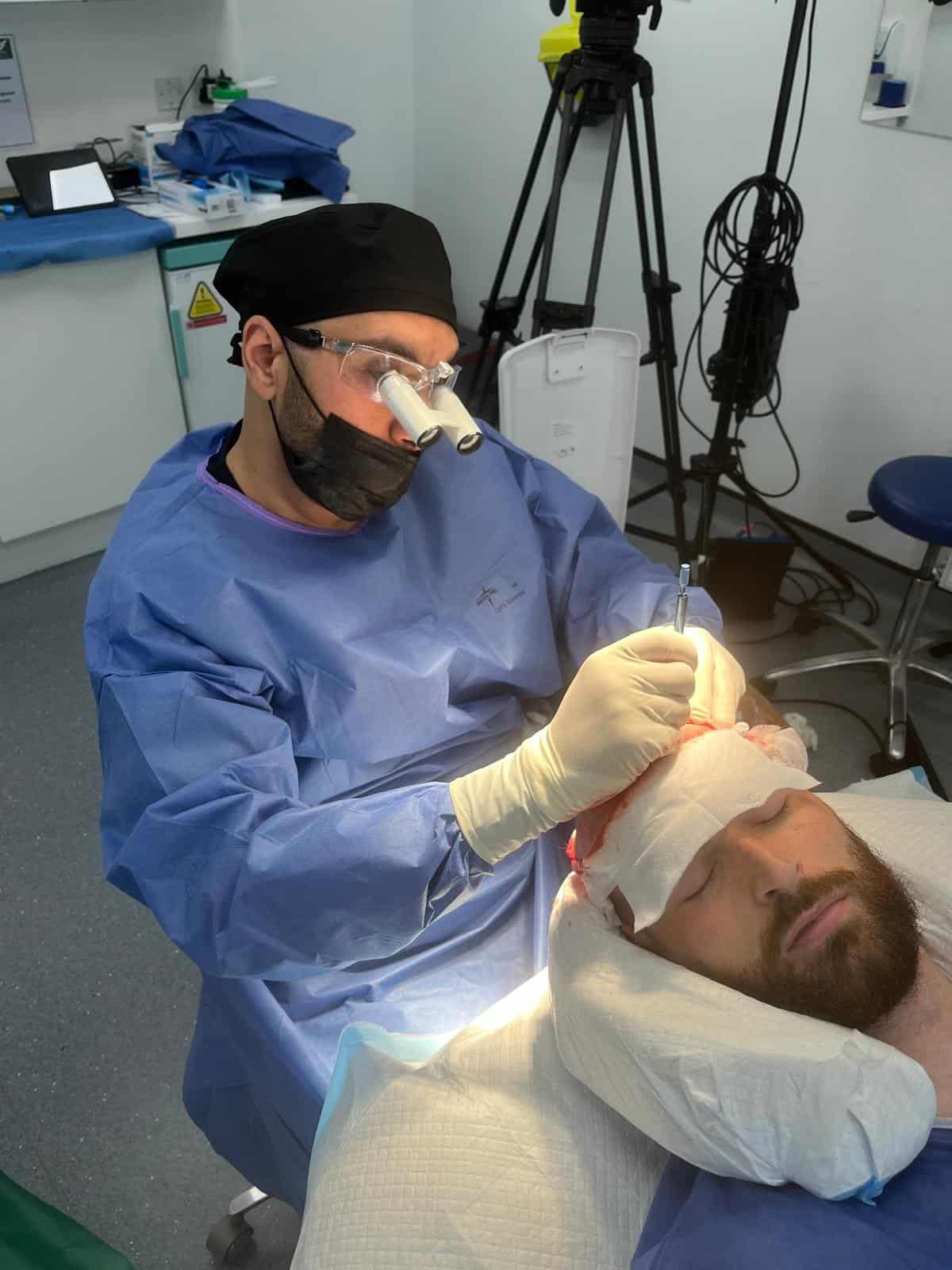
With any hair transplant technique, a successful hair transplant is not only built on the amount and quality of hair growth achieved, but also good donor management, limiting the changes to the donor region. Hair follicles are finite and should be treated by the clinic as gold dust, with everyone precious to the final long-term result. Limiting the damage should therefore be the priority.
It would be considered “normal” to expect a doctor to play the key role in your surgery. Traditionally, and correctly, the hair transplant doctor would perform a consultation, plan the procedure, manage the donor, check density, hairline design, administer medications and anaesthesia and perform as a minimum the surgical aspects of the procedure.
A team of technicians will support the doctor; they have specific duties to ensure the procedure is run without delay, and correctly. It´s impossible for one person to do everything in a suitable time frame, it is not feasible to excise a strip or punch, extract, clean and trim the grafts, make the recipient sites and then place the hair, this would massively reduce the size of procedure that could be performed, notwithstanding the fatigue element of one individual doing everything.
The lead surgeon or medical doctor is responsible for the overall care of the patient, even if they delegate the surgical task to a medically unlicensed technician. For instance, if a technician over harvested the donor, damaged the grafts they tried to extract, burst the hair bulb when placing the graft, the doctor would be held liable. Of course, the technician may also face consequences, but in the eye of the law, the medical procedure responsibility lays with the doctor.
FUT and FUE Donor Harvesting
FUT Steps
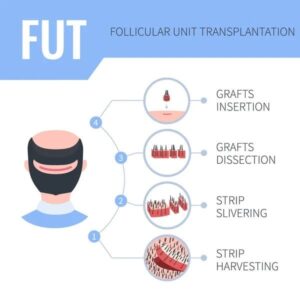 FUT requires a high degree of surgical skill, the doctor can only perform this step, and today, not all hair transplant doctors are proficient in the FUT technique, so only offer FUE. The excising of the strip requires experience and surgical knowledge to open and then carefully suture the wound, the width of the strip will affect how well the wound is closed, along with the skin laxity.
Surgical techniques such as undermining separates the skin and subcutaneous fat from deeper connective tissues to reduce tension across a wound edge before suturing. The depth of the incision is controlled to not go deep into the fatty tissue and create fibrosis which will hinder the quality of the healing, maybe causing the scar to stretch. The type of suture used, dissolvable or permanent, needing removal by the clinic in running method, a continuous suture along the length of the wound. It is best for long wounds and distributes tension evenly. This is all the sole domain of the doctor, as with our lead surgeon, Dr. Aziz Elgindi when performing FUT.
FUE Steps
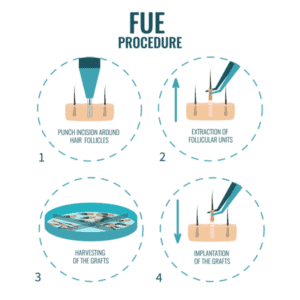 FUE in its infancy was always a doctor performed procedure, with any incisions into the skin only being made by the Doctor. But over the years the FUE hair transplant standards and protocols have been diluted, with the lines between who performs what, blurred.
The doctor must manage the FUE donor harvesting before they even pick up a punch and calculate what can safely be extracted from each area of the donor whilst maintaining a balanced level of hair coverage, rather than simply start punching.
FUE is a blind technique; the doctor can only see the hair shaft as it exits the skin and obviously cannot see below the skin surface, therefore aspects of the hair follicle cannot be examined until after they have been removed. As a result, this requires an experienced and knowledgeable doctor with an understanding of hair/skin anatomy and characteristics. To maintain a low transection rate, accurate depth control, and follow the correct angle and orientation of the hair follicles under the skin surface. All needing a medical understanding of the hair and skin, and not for a lay person.
The doctor, maybe aided by technicians to remove or extract the hair graft after it has been punched, this is not a surgical step, simply removing the graft.
Technician Led FUE Hair Transplants
Overtime, a style of clinic started to allow technicians to take over surgical aspects of the procedure, in part, but this evolved to clinics adopting the model to allow technicians to fully perform the procedure, punching, extraction and graft placement. Technicians are generally not medically qualified; as a result, clinics are performing what are surgical steps of the procedure using non/medically certified staff.
This is contrary to the UK guidelines set by the General Medical Council (GMC), the British Association of Aesthetic Plastic Surgeons (BAAPS), and the Cosmetic Practice Standards Authority (CPSA). In recent years, the ISHRS, The International Society of Hair Restoration Surgery has taken an uncompromising approach against technician-led hair transplant surgery. According to the ISHRS Position Statement on Qualifications for Scalp Surgery, any procedure involving a skin incision on the scalp constitutes a surgical act and must be performed exclusively by a licensed, trained physician.
Technician led FUE hair transplants often go hand in hand with low-cost clinics, but not always the case. The Technician takes a larger physical role in performing the hair transplant procedure, taking over the punching step, often with multiple technicians punching at the same time, on each side of the head this can create issues, greater scarring, and hair miniaturisation to name two. The doctor’s role is greatly diminished, occasionally to the periphery, maybe the consultation, signing off the procedure, informing the techs of the required graft numbers, not even administering the anaesthesia and other medications in cases. This often goes together with using lower cost and quality surgical instruments.
Technician-led hair transplants allow a clinic to employ more staff at a fraction of the cost of a doctor, do more procedures per day, forgo critical steps in the procedure, notwithstanding putting speed over exacting standards and protocols. For instance, this often goes together with clinics offering mega FUE sessions, 4-5000 grafts in a day procedure. Their goal is to achieve the desired number count in the fastest time possible, hence having multiple techs punching together. Profit over protocols.
Larger procedures performed by non-medically trained technicians will over harvest areas, and likely increase obvious scarring, may cause the hair remaining to miniaturise due to trauma and cause shock-loss.
When there is little to no donor management protocols, no real thought to an educated extraction pattern, or spreading the extraction, which is impossible with the mega sessions they perform, and no consideration to the transection rates, the percentage chance nothing goes wrong is low, with a large chance damaged hair follicles are used, causing poor growth, just one of the many reasons why an FUE procedure performed by a low skill set, non-medically trained technicians can fail.
Why FUE Donor Punching Should Be the Domain of the Doctor
Harley Street Hair Transplant Clinics surgeons, Dr. Aziz Elgindi and Dr. Mohammed Ditta, not only do all the punching themselves, they are fully integrated into the entire procedure, creating the custom-made recipient sites, whilst monitoring the procedure, step by step.
Hair Characteristics, Angles, Orientation, and Depth Control
Hair characteristics have a large part to play in the quality of a hair transplant result and will influence the doctor´s approach to the extraction process. The shape of the hair follicle dictates the character of the hair, round, oval and elliptical, straight, curly/wavy, and coiled hair shafts. The hair may exit the head one way, but that does not mean the punch automatically follows the same direction of the hair shaft. The hair follicle may go back on itself under the skin. This can mean the seating position of the doctor can make subtle adjustments, also to their wrist position when holding the punch to ensure they compensate as the angles naturally change.
Transection
Transection is the cutting of the hair follicle under the skin, either fully cutting through the entire follicular unit, or splitting a multi hair unit, damaging the total follicular unit. If the individual punching does not understand different traits to the hair follicle the transection rate will spiral, making the hair impossible to use, and reduce the total number of hair available over one or multiple procedures. Both of our hair transplant surgeons will monitor his transection rate during the procedure to ensure it is minimal. By minimal what we mean is that an acceptable transection rate is typically 5% and under. Our surgeons on average have a 2-3% rate.
An Educated Extraction Pattern
The back of the head has the highest hair and follicular unit count and is also the easiest area of the head to extract from, due to the position and how the hair lays. As a result, there can be the temptation to remove all the hair from that area, leaving the sides untouched. This is fine for smaller sessions as the graft count is lower and changes to the density can still be spread over a wide area. So, the doctor will measure the hair density in multiple areas, calculate the mean density and punch accordingly over a wider area.
Graft punching was always the domain of the doctor, in the early days even five hundred grafts were considered a day procedure, due to the limited understanding and the punches only being manual. This increased to a doctor being able to punch two thousand plus per day on good candidates, and improvements in the instruments have certainly helped. But it was always the doctor´s responsibility to perform what is, in manners, ethically, medically, technically a surgical step in performing an FUE hair transplant.
Research
A hair transplant is elective surgery; it is sensible to research before deciding. A golden rule – never judge the competency of one clinic by the standards of another. If the assumption is because they are all medical so must have comparable standards, that would be incorrect. Standards vary greatly and should not be assumed all clinics work by the same standards and protocols.
A hair transplant may be a relatively minor surgical procedure; but it is still a surgical procedure, and a doctor should always perform specific steps in the process. It will be one of the biggest decisions you make. As much as it can have an incredible positive effect on your life, a poorly performed hair transplant can have a much deeper negative impact, likely for the rest of your life. You don´t want to be on the wrong side of this. Hair transplant repair surgery may be able to improve a bad hairline or poor growth, but it will leave scarring, and once the donor region is damaged there is little to nothing to improve it. Damage to the skin, over harvesting leaving patchy areas, shock-loss, and the overall needless waste of hair, all due to incompetency, ignorance, and lack of skills.
It´s unlikely a clinic will detail on their website or simply tell you the doctor does not play the pivotal role, without being prompted. So, it must be confirmed. Ask the clinic to confirm who does all the punching, the doctor does all, partly, or do the technicians perform all the punching. Have it confirmed in writing, to avoid problems if you ultimately decided on said clinic.
Never assume the doctor will perform the FUE punch. You do not want any surprises, lying face down on the chair, head shaved, medications taken and one or two technicians start to punch your donor. You are in an awful situation, do you stop, allow them to continue, either way, you would have lost all faith in the clinic if you simply assumed the doctor performed all the punching.