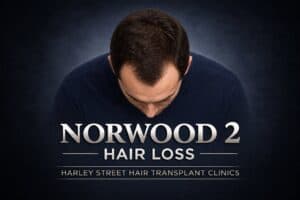





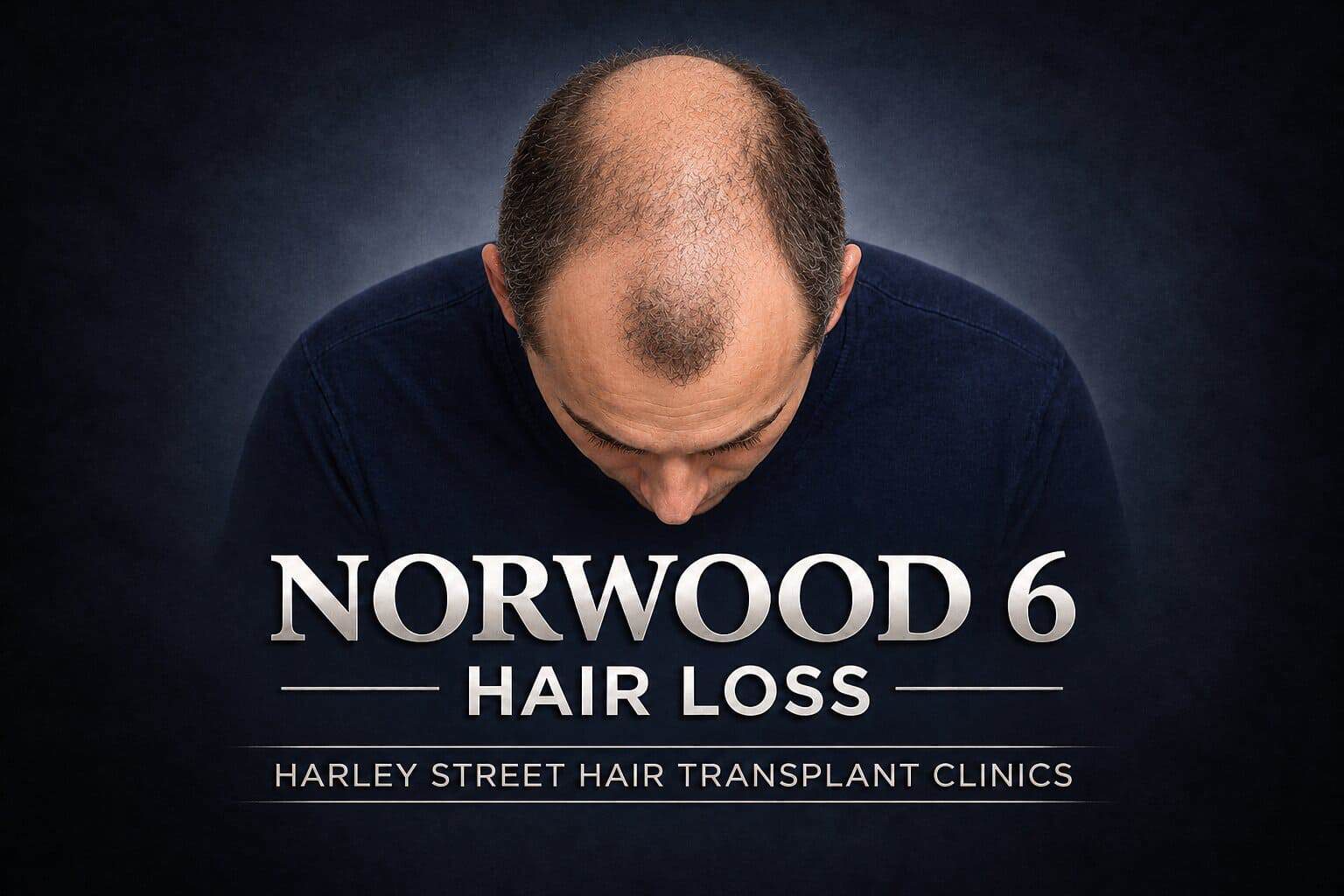
The Norwood Scale superseded the Hamilton Scale, as the hair loss pattern classification for male pattern baldness (androgenetic alopecia). In the 1970´s Dr. O’Tar Norwood updated Dr. James Hamilton´s original scale from the 1950s to include the crown, or vertex in the classification. The scale denotes the progression of hair loss over seven stages.
Norwood Stage 6 – this advanced hair loss pattern is only beaten by the Norwood 7 stage. This hair loss pattern does not stay localised to the top of the scalp, from the temples to the crown. Instead expands down the laterals, the size of the head, and the crown continues to open around the back of the head. The aesthetic is often characterised as a horseshoe pattern, with a relatively thin band of hair around the sides and back of the head. At this stage it is also common that the nape hair suffers from retrograde alopecia.
Norwood 6 Structural Characteristics
In earlier stages of androgenetic alopecia, or male pattern hair loss, up to roughly Norwood 3, typically two distinct areas are affected, the temple recession and hairline, and the opening of the crown, or vertex, for example categorised as Norwood Stage 3V (vertex). With a Norwood 6 Stage, not only are these two areas no longer separated, but the surface area of hair loss has also expanded down the back and sides of the head.
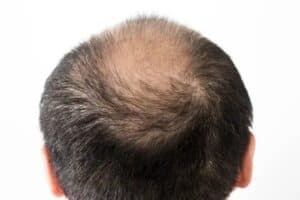 Lateral Wall Drop: The hair on the sides of the head, the parietal walls, have dropped, as a result, the upper boundary of hair growth has moved downward closer to the ear.
The “U” crown: whereas with the Norwood 5 hair pattern, the crown remains high, kissing the top back of the head. Norwood 6, a U shape, or horseshoe shape develops as the crown drops down the back of the head, occasionally to the occipital area. When viewed from the back a classic U shape is apparent.
Hormonal Factors: DHT
The driver behind androgenic alopecia Norwood 6 hair loss pattern is the genetic lack of resistance to a naturally produced by-product of testosterone and 5-alpha reductase, called dihydrotestosterone (DHT). Genetically sensitive hair follicles possess a high concentration of androgen receptors.
The Norwood 6 hair loss pattern simply has more active androgen receptors on the hair follicles over a wide surface of the scalp compared to lower Norwood hair loss stages. Dihydrotestosterone attaches to the hair follicle and triggers the male pattern baldness process, which in turn changes the hair growth cycle.
Anagen Phase Shortening: this is the growth phase, which is the longest phase typically but starts to become shorter. Initially resulting in less hair actively growing over the scalp, to the miniaturising of the hair shaft and finally the hair follicle ceasing hair reproduction.
Telogen Phase Lengthening: as the growth phase shortens the resting phase becomes longer, resulting in no hair growing activities within the hair follicle.
The hair shaft reduces in calibre with each cycle, the shaft diameter reduces, the hair shaft becomes shorter, a lighter tone as the pigment content reduces. All as the hair follicles atrophy away from the blood supply. The movement from terminal hairs to vellus hairs, thick terminal hair growth to the finer, stunted low calibre vellus hair. The final stage of the hair follicles growth phase is when it permanently atrophies, detaches the connection to the blood vessels, and ceases the production of hair.
The remaining band of hair around the back and sides of the head continues to grow, being immune from the male pattern baldness gene. The hair follicles in the band of hair do not carry the androgen receptor as a result not impacted by DHT.
Social Impacts of Norwood 6
 It takes years to arrive at a Norwood 6 hair loss stage, as a result it would be assumed the individual has years to come to terms with the hair loss. However, even compared to the previous stage, Norwood 5, the NW6 hair loss pattern is that much more aggressive. As hair loss starts to affect the back and sides it gives an increased level of hair loss and can have a deeper psychological impact. Even Norwood 5 often has a slight diffused partial hair coverage over the top of the scalp from the temples to the crown, with the back and sides remaining totally intact. With the hair boundary dropping down the sides and the potential of retrograde alopecia the aesthetic pattern of hair is much more aggressive. Individuals may experience a profound shift in how they see themselves, the facial framing changes, adds years to the look of a man.
Styling Options: while the exact ratio depends on the individual’s scalp size, a Norwood 5 is generally considered at the point when the hair to baldness ratio can be about even. However, with a Norwood 6 hair loss pattern the ratio is certainly in the favour of more baldness and less remaining hair. As a result, changes the dynamics of treating the hair loss stage. Norwood 6 removes any styling options as such, with only shaving the remaining hair possible, to reduce the contrast between hair and skin. The shaving approach is common amongst the high Norwood stages, and with the right head shape can deflect from the lack of hair.
Medical Treatment for a Norwood 6 Hair Loss Pattern
To reach a Norwood 6 hair loss pattern will have taken years, over this time the hair follicles affected by the male pattern hair loss gene will have mainly fully atrophied. As a result, using any hair loss treatments such as Minoxidil or Finasteride are going to have minimal to no impact of the level of hair growth.
Surgical Hair Restoration
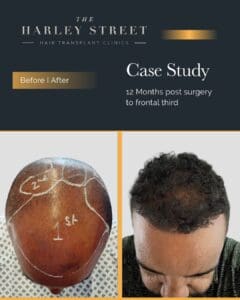 The concern treating a Norwood 6 hair loss patient with a hair transplant is the simple problem, of lack of resources. The band of hair around the back and sides has shrunk to the point there is now balder scalp than hair covered scalp. Even though a hair transplant does not have to replace like for like hair lost, the finite donor of a Norwood Stage 6 patient is small, as a result, not enough can safely be removed to deal with the entire area of hair loss, with a high donor-to-recipient deficit.
Because there is not enough donor hair available at the back and sides of the head to completely restore a Norwood Stage 6 scalp, for a hair transplant to be considered the candidate must fully appreciate the limitations involved.
Planning for Treatment of a Norwood 6 Hair Loss Pattern
A doctor´s approach to performing a hair transplant on a Norwood 6 candidate must follow certain criteria to maintain a natural, if partial hair coverage.
Aesthetic Priorities: the front third of the scalp, from the hairline to roughly the back of the ears is given priority. The hairline frames the face, even a conservative open temple hairline frames the face and has the most impact when people see during direct eye contact.
A Mature Hairline & Density: the hairline must be designed with a conservative approach, meaning the apex must be relatively high on the forehead, with a more acute angle to the temporal recession. This will create a perfectly natural appearance of hair growth even if the hair coverage going back is minimal.
Hair grafts are placed close enough together along the immediate hairline to create the defining frontal line, as the coverage moves back toward the mid-scalp, the look of density can be reduced to aid hair coverage but still must maintain enough fullness to appear lower but not spread.
Limitations of Hair Coverage: at the top back of the head, the crown will consume a massive number of grafts due to the pattern of hair growth as it has a huge appetite for hair. This is exacerbated further with a Norwood 6 as the hair boundaries have dropped further down the back and sides, adding even more balding surface area, and at the same time, reducing the size of the donor area.
Harvest Techniques: FUE vs. FUT
Follicular Unit Transplantation (FUT / Strip Technique): Often the go-to hair transplant harvesting technique for the high Norwood stages. The strip is removed from the hair rich donor region on the occipital bone. If the donor follicular unit (FU) hair density has remained around average per cm², (75 FUcm²) the doctor can harvest a strip with around 3500 grafts, while preserving the hair density around the linear strip.
Follicular Unit Extraction (FUE): as FUE donor harvesting spreads the extraction around the safe donor, and removes individual follicular units, the number of grafts that can safely be removed will be much less than FUT, that is without over harvesting. As the area of donor hair is small trying to remove FUT type graft numbers will mean overly scarring the area and leave visibly thinner patchy hair-less areas.
Combination Surgery: For those doctors able to safely perform both FUT and FUE it is possible to combine the techniques into one, two-day procedure. This combo surgery will maximise the number of grafts that can safely be harvested, consequently max the hair coverage that can be achieved.
Body Hair Transplants (BHT): body hair, chest, leg, back and beard hair are common body hair donor resources. When the scalp donor has been exhausted, doctors can turn to body hair, however, the hair characteristics must be close to the scalp hair to maintain a natural look. Although body hair generally only grows in single hair units and is best used to improve fullness rather than standalone hair coverage.
Non-Surgical and Alternative Solutions
When a hair transplant is simply not an option, be it partial hair coverage, poor donor area, cost prohibitive, or not wanting a surgical procedure, then the next option is a non-surgical solution.
Scalp Micropigmentation (SMP)
Scalp Micropigmentation is a medical-grade tattooing technique that applies thousands of micro-dots of a dark toned pigment to the surface of the skin. SMP is commonly used to create the shaved hair look, the dark toned dot of pigment can look like shaved hair. Any remaining hair must be kept shaved otherwise the illusion is lost. As there is no donor resource, only bottles of pigment, any hair loss pattern, including Norwood 6, can be created to give the illusion of a strong hairline and coverage over the entire recipient area. The SMP technician must have a strong understanding of hairline design, too high or low, the wrong angles will leave an unnatural look.
SMP commonly take three sessions over weeks to fully build a solid result. The first sessions the pigment fades until enough is absorbed into the skin then it sustains a strong lasting tone. SMP works best when there is a medium to high contrast between the dark tone and the skin complexion.
SMP requires no daily styling or treatment, although washing your hair must cease for around a week after each session. The pigment will fade overtime, with SMP lasting from around one year to maybe three years, before a touch-up is required.
Hair Replacement Systems
A custom-made hair system can use synthetic or real human hair injected into a synthetic base. The bases can be open, monofilament so the scalp can breathe, or a closed non-porous layer of polyurethane, a silicone membrane so when the hair is parted looks like skin.
They can feature a lace attachment to the hairline, allowing for a more realistic subtle hairline. Real hair is charged at a premium and comes either with the cuticle removed or left on, with the cuticle left on is called diamond hair as it reacts more like real scalp hair.
The system is bonded either around the perimeter of the system if the base is open, or all over if a silicone membrane. They both remain attached and secure for between 2 to 4 weeks, as the hair below grows longer.
The maintenance can be high to keep a natural look, as there are no natural scalp oils to keep the hair system and the natural hair looking the same, same with perspiration. The systems will lose hair and need repairing or even changing, as well as needing specialist care for taking off each month, cleaning and re-bonding to the scalp.
FAQs
No. Once the scalp has reached a Norwood Stage 6, the hair follicles in the bald regions have typically completely ceased the production of hair. No stimulant or DHT suppressor is going to have any meaningful positive impact on the scalp hair growth.
To restore complete, natural looking hair density coverage from the temples to the crown on a Norwood 6 scalp, would likely require 8000+ grafts. However, due to the nature of a Norwood 6 donor area the resources are simply not there. In fact, on an average Norwood and average donor hair density, very few candidates will be able to reach 8000 plus grafts.
You can be a candidate, but the higher the Norwood FUE harvesting becomes problematic. The random punching of the grafts around the donor thins out the hair density, as the Norwood 6 donor is small, it would have to be over harvested to achieve a reasonable graft count. Maybe consider a combo surgery to max the harvesting protocol.
There is no fixed age at which hair loss automatically stops. Androgenetic alopecia is a progressive, genetic condition, as a result commonly follows a similar hair loss pattern to other family members. While the rate of shedding may slow down significantly after a man reaches his 40s or 50s, the miniaturisation process continues if androgens are present in the body.