




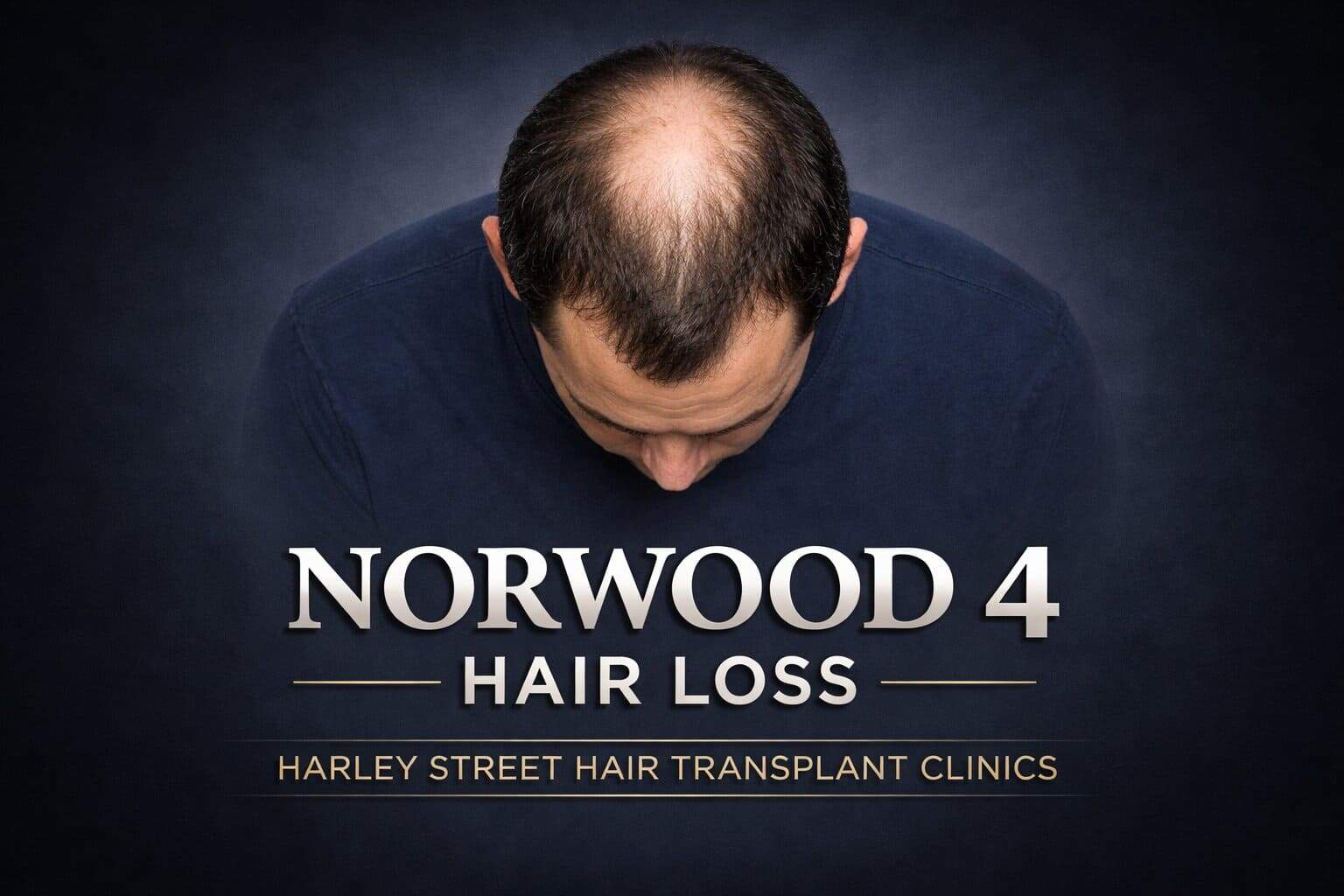
Norwood 4 is a classification within the Hamilton-Norwood Scale, which measures the progression of male pattern baldness (androgenetic alopecia). Stage 4 hair loss is categorised by a receding hairline and bald spot on the crown. Hair loss medications (e.g. finasteride) can stabilise Norwood 4 hair loss; hair transplant surgery is the only way to reverse hair loss from hereditary pattern baldness.
Overview
Norwood 4 is a common stage of male pattern baldness where hair loss becomes clearly visible at both the hairline and crown. Classified within the Hamilton–Norwood Scale, this stage is defined by deep temple recession, a distinct bald spot on the vertex, and a band of thinning hair separating the two areas. For many men, Norwood 4 represents the point where hair loss becomes difficult to conceal, leading them to consider medication or a hair transplant.
What Does Norwood 4 Mean?
If you’re experiencing hair loss and have visited a hair transplant clinic for a free consultation, then you may have been told you’re a “Norwood Stage 4” on the Hamilton-Norwood Scale. At this stage of male pattern baldness, many men feel this is the point where hair loss feels impossible to ignore. But what does “Norwood 4” mean?
Norwood 4 is a stage of male pattern baldness defined by significant frontal recession (i.e. receding hairline) and visible crown thinning. It sits within the Norwood scale, the clinical grading system used worldwide to measure the progression of androgenetic alopecia in men.
At this stage, hair loss becomes clearly established rather than gradual or subtle. Norwood 4 is considered the mid-point in male pattern hair loss. If you’re at this stage, several treatments will help you maintain hair density or fully reverse your hair loss, but it is important to act quickly as further progression quickly limits potential options.
Norwood 4 Symptoms: The Three Defining Features
Male pattern hair loss has a very particular progression. As such, a diagnosis of Norwood 4 is typically based on three visible characteristics:
- Deep Temple Recession – the hairline forms a pronounced “M” shape, with significant thinning or baldness at both temples. Some men may also see thinning in the central portion of their hairline.
- Distinct Crown Bald Spot (Vertex Thinning) – a separate area of thinning appears at the crown, often visible in overhead lighting or photos.
- A Mid-Scalp Hair Bridge – a band of hair remains between the frontal hairline and the crown. This “bridge” distinguishes Norwood 4 from more advanced stages such as Norwood 5 and 6, where this connection begins to thin or disappear.
Why Norwood 4 Is a Turning Point
For many men, Norwood 4 represents the stage where hair loss becomes difficult to conceal. Hairstyles that once worked (like the combover) no longer provide coverage, and thinning is noticeable from multiple angles, particularly in bright light or when the hair is wet.
Clinically, this stage is significant because the pattern of loss is usually well established, a patient’s donor hair at the back and sides is often still strong, and treatment planning becomes clearer and more predictable.
From our experience conducting thousands of consultations each year, patients with Norwood 4 explore several treatment options and can be split into three categories:
- The “stabilisers” – stabilisers are patients who prefer a low-cost treatment that will stop their condition getting any worse before they consider a more drastic option like PRP injections or hair transplantation. These patients usually consider DHT-blocking medications like finasteride, or dutasteride.
- The “Thickeners” – thickeners are patients who aim to promote hair growth on the crown area, usually through PRP therapy, micro needling, and/or vasodilating medications like minoxidil. Treatment options for Norwood 4 vary.
- The “Restorers” – restorers are decisive patients who don’t just want to stop things getting any worse. They focus on reversing hair loss and putting hair back in areas where hair follicles have miniaturised. The only way to do this is with a hair transplant (e.g. FUE, DHI, or FUT).
In short, Norwood 4 is not “advanced baldness,” but it is a decisive progression point. It often prompts men to explore medical options (oral or topical medication, PRP therapy) or hair transplant surgery for the first time.
Can Norwood 4 Progress Further?
Yes. Without treatment, Norwood 4 can worsen. While the hairline recedes significantly, sufferers from hereditary male hair loss will also see continued thinning on the crown area. Subsequent phases of the Norwood scale include:
- Norwood 5 (bridge thins further)
- Norwood 6 (bridge disappears)
- Norwood 7 (advanced balding pattern)
Early intervention protects both your native and transplanted hair. Beyond stage 4 on the Norwood Scale, patients will likely require multiple surgeries to attain full coverage of the frontal hairline, crown, and bridge.
What Causes Norwood 4 Hair Loss?
The progression to Norwood 4 is caused by the condition male pattern baldness (androgenetic alopecia). Pattern hair loss is hereditary (in other words, down to our genetics), and primarily driven by the body’s sensitivity to powerful male sex hormones
Genetics
Male pattern baldness, including progression to Norwood 4, is strongly influenced by inherited genetic sensitivity to DHT (dihydrotestosterone). The condition is believed to be polygenic, meaning it is influenced by multiple genes rather than a single “baldness gene.”
While many people believe hair loss is inherited solely from the mother’s side, the reality is more complex. Genetic predisposition can come from either parent’s lineage, and family history on both sides should be considered.
If your father, uncles, or grandfathers reached Norwood 4–6, they experienced noticeable crown thinning in their 20s or 30s, or their hair loss followed a clear M-shaped recession with vertex balding, then your likelihood of following a similar trajectory increases. This is usually discussed with patients during their initial consultation.
However, genetics determine “predisposition”, not exact timing or severity. Two brothers with the same parents can progress at different speeds depending on hormonal sensitivity, lifestyle factors, and overall health.
DHT Sensitivity
Men genetically predisposed to androgenetic alopecia have hair follicles that are sensitive to DHT (dihydrotestosterone). Over time, DHT molecules bind to androgen receptors on the hairline and crown, causing hair follicles to shrink.
Over time, DHT shortens the hair growth cycle, producing thinner, weaker hairs until they die. This form of hair loss is permanent and progressive, meaning miniaturised hair follicles won’t ever grow back.
Age & Progression Timeline
Most men reach Norwood 4 between their late 20s and early 40s, although aggressive hair loss can occur earlier. Early-onset Norwood 4 (under 30) often indicates stronger DHT sensitivity and a higher risk of future advancement. In these cases, our patient advisor and surgeon usually recommend medical stabilisation before surgical intervention.
The transition from Norwood 3 to Norwood 4 can happen gradually over several years, or more rapidly in men with aggressive androgenetic alopecia. While two patients can present with the same symptoms, the rate and age at which the condition manifests does impact treatment options.
Clinically, age matters because it affects surgical planning. A 28-year-old at Norwood 4 requires a more conservative, long-term strategy than a 45-year-old at the same stage, as future progression must be anticipated to protect donor supply and avoid unnatural density patterns later in life.
How is Norwood Stage 4 Diagnosed?
Diagnosis of Norwood Stage 4 is usually straightforward and based on a clinical assessment with a hair transplant surgeon (or patient advisor) and a Trichoscopy.
A hair restoration specialist will compare your pattern against the Norwood scale, assess your donor area density, and evaluate the extent of your crown thinning. From here, a decision will be made as to whether you are a Norwood 3 or 4.
In some cases, high-magnification imaging during a Trichosopy will be conducted. Especially, in cases where a patient is considered a hair transplant. This allows a clinic to detect miniaturised hairs, measure density per cm², and identify active shedding zones on the scalp.
Treatment Options for Norwood 4: Medication or Hair Transplantation?
If you are a stage 4 on the Norwood Scale, then a treatment plan is largely dependent upon aims and expectations. You will have already seen extensive hair loss in the hairline and temples, as well thinning hair on the crown.
The two main options most patients consider are hair loss medications (e.g. finasteride, dutasteride, minoxidil) and hair transplant surgery. Although, it all depends on whether you are looking to maintain hair density or restore hair follicles that have been lost during recession/thinning.
Stabilising Norwood 4 Hair Loss: Medication
Before surgery, stabilising hair loss is essential. Medication will help slow the progression of hereditary hair loss, strengthen existing hair follicles, and (in some cases) improve crown density. However, medication alone rarely restores a fully receded hairline at Stage 4.
Finasteride and Dutasteride are medications that block the conversion of testosterone to dihydrotestosterone (DHT), which contributes to hair loss. Conversely, Minoxidil is an over-the-counter topical solution that can promote hair growth and slow further loss when used consistently.
If you’re considering medication, a DHT-blocker and vasodilating medication is usually advised. If you’re worried about side effects when treating Norwood 4 hair loss, then you may want to consider a topical finasteride/minoxidil solution.
Reversing Norwood 4 Hair Loss: Hair Restoration Surgery
Typically, a Norwood 4 hair transplant requires between 2,000 to 3,000 grafts to achieve a natural and full appearance. Most patients who opt for a hair transplant with Norwood 4 hair loss tend to have an FUE procedure. Although, FUT and DHI can be performed.
After patients have had a hair transplant, medication is still recommended as this will help prevent further hair loss progressing.
How Many Grafts Are Needed for Norwood 4?
If you’re considering a Norwood 4 hair transplant, then the number of grafts you will need depends on the size of your crown, your desired density, and donor supply. Furthermore, not every patient with Norwood 4 hair loss requires a crown surgery as well as their hairline.
Typical UK graft ranges for a Norwood 4 surgery are:
- 2,500–3,500 grafts for frontal + crown
- 1,800–2,500 for frontal-only restoration
If you’re considering a Norwood 4 hair transplant, then book a free consultation today to discuss your options.
Final Thoughts: Treating Norwood 4 the Right Way
Norwood 4 represents a clear turning point in male pattern baldness. While it can feel advanced, it is still highly treatable with the right strategy. The key to successfully treating this extent of hair loss is an accurate diagnosis from a patient advisor, medical stabilisation before surgery, and conservative, long-term planning by your surgeon.
If you’re currently at Norwood 4, understanding your options now gives you control over how your hair loss progresses rather than reacting later when donor supply becomes limited. If you want to stop losing hair, book a free consultation today.