




Norwood 5 is an advanced form of male pattern baldness (androgenetic alopecia), affecting the hairline and crown area on the scalp. In this article, we’ll explain the causes, symptoms, and treatments for Stage 5 male pattern hair loss. Book a free consultation today.
What Is Norwood 5?
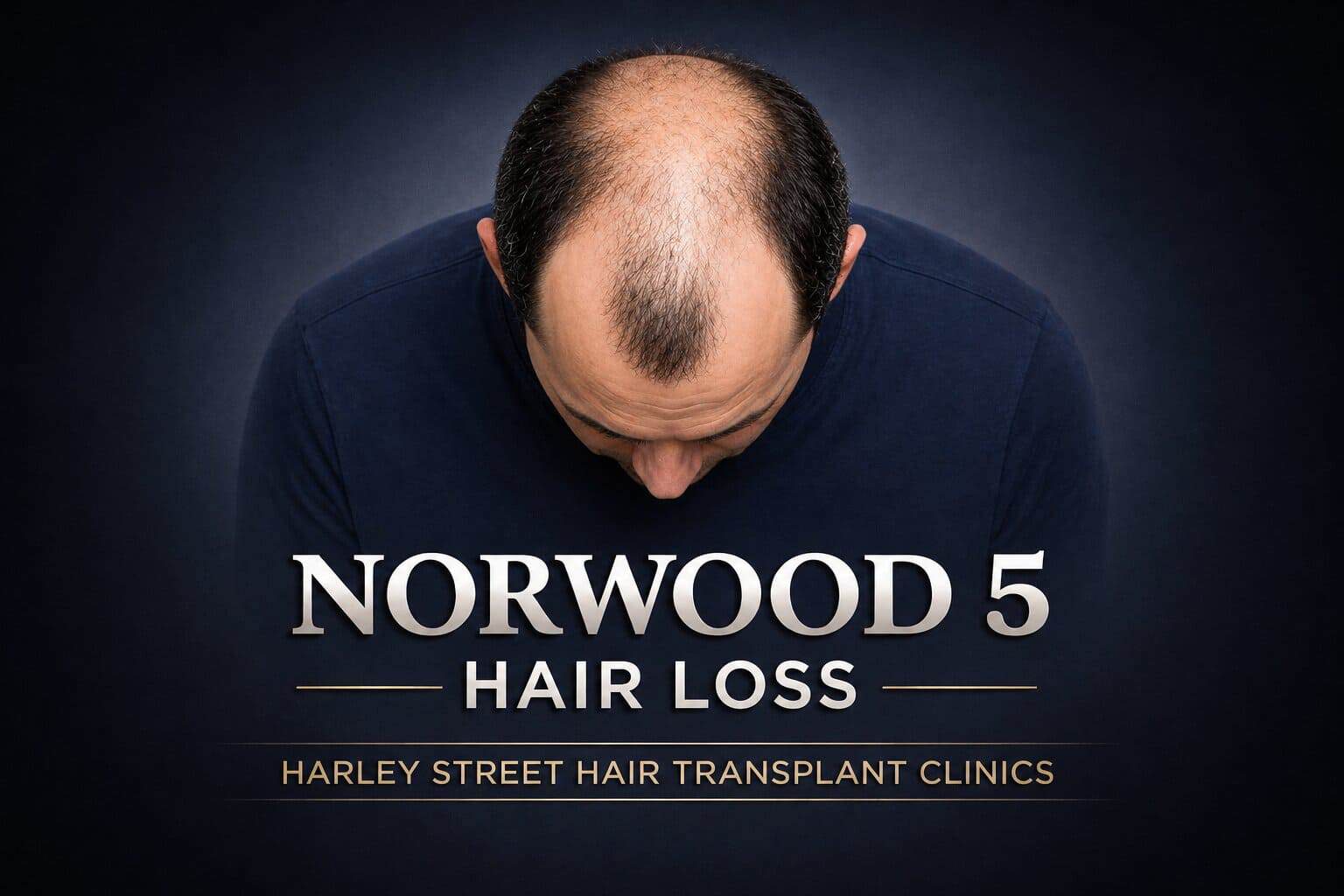
Norwood 5 refers to an advanced stage of male pattern baldness where a person’s hair loss has progressed significantly beyond a temple recession. Stage 5 on the Hamilton-Norwood Scale is categorised by hairline recession and significant crown thinning (i.e. a bald spot on the head), leaving only a narrow band of hair (i.e. bridge section) separating the two areas.
The Norwood scale, also known as the Norwood–Hamilton scale, is a classification system used to measure the stages of male pattern baldness (androgenetic alopecia). Hair loss usually begins around a Norwood Stage 3 (receding hairline), continues to a stage 4 and then stage 5 (affecting the hairline and crown area), and often progresses to a Stage 7 (fully bald).
At stage 5 on the Norwood scale, the hair loss pattern becomes much more noticeable and difficult to conceal. Many patients looking to combat this level of hair loss require a hybrid treatment approach of a hair transplant (usually the DHI or FUE method) and medication (finasteride and minoxidil).
Key Characteristics of Norwood 5
Typical signs of Norwood 5 include:
- Significant recession at the temples
- A large bald spot on the crown (vertex)
- The bridge of hair separating the front and crown becoming thin
- A horseshoe-shaped band of hair remaining on the sides and back
- Reduced overall hair density across the scalp
Compared to earlier stages of hair loss, Norwood 5 hair loss usually requires medical or surgical intervention if you want to restore density.
What Does Norwood 5 Hair Loss Look Like?
At Norwood stage 5, the balding areas at the crown and hairline begin to merge. The strip of hair that once separated them becomes thinner and weaker. This creates the classic “U-shaped” or horseshoe pattern of hair around the sides and back of the head.
Although the top of the scalp has significant hair loss, the donor area (i.e. the hair at the sides and back) is usually still strong. This is important because these follicles are typically used in hair transplant procedures, helping sufferers of male pattern baldness restore their hair and self-confidence.
Many patients seek treatment at this stage because:
- Hair loss becomes difficult to hide
- Hairstyles can no longer cover the thinning
- Self-confidence may begin to suffer
The good news is that Norwood 5 is still very treatable, particularly with modern hair restoration techniques. While this is considered advanced hair loss, a surgeon-led hair transplant and rigorous aftercare routine can help restore hair and promote hair growth for many years to come.
What Causes Norwood 5 Hair Loss?
Norwood 5 hair loss is almost always caused by male pattern baldness, also known as androgenetic alopecia. This condition is driven by a combination of genetics and hormones.
Genetics
Your genetic makeup plays the biggest role in determining whether you will experience hereditary hair loss. If male pattern baldness runs in your family, you are significantly more likely to develop it yourself. The genes responsible for hair loss can be inherited from either side of the family.
Genetics determine when hair loss starts, how fast it progresses, and how severe it becomes. Some men may remain at Norwood 2 or 3 for decades, while others progress to Norwood 5 or higher relatively quickly.
DHT Sensitivity
The hormone dihydrotestosterone (DHT) is the primary driver of male pattern hair loss. DHT is a powerful male sex hormone derived from testosterone and attaches to androgen receptors on the scalp, affecting genetically sensitive hair follicles.
Over time, DHT causes a process called miniaturisation, where hair follicles gradually shrink. If you are experiencing male hair loss, you may have already experienced these symptoms:
- Thinner hair strands
- Slower hair growth
- Shorter hair growth cycles
- Eventually, follicle dormancy
The hair follicles at the front and crown of the scalp are particularly sensitive to DHT, which explains why hair loss typically begins in these areas. Once a patient progresses to stages 4 and 5, hair follicles on the crown tend to be affected next.
Age
Hair loss from androgenic alopecia tends to progress with age. While some men reach Norwood 5 in their twenties or thirties, others may not reach this stage until their forties or fifties.
As the years pass, the cumulative effects of DHT and follicle miniaturisation become more pronounced. Especially when a patient has not taken preventative medication like finasteride to stop hair loss in its tracks.
Symptoms of Norwood 5 Hair Loss
The transition to Norwood 5 usually happens gradually. Many men first notice early signs years before reaching this stage. Common symptoms of Norwood stage 5 include:
- Receding Hairline – the hairline moves further back, particularly around the temples. This creates a deeper M-shaped hairline compared to earlier stages.
- Expanding Crown Bald Spot – the bald spot at the crown grows larger as hair density decreases. At Norwood 5, this area becomes clearly visible.
- Thinning Bridge Between Front and Crown – the strip of hair that once separated the two balding areas becomes sparse and weak. This is one of the defining characteristics of Norwood stage 5.
- Reduced Hair Density – hair across the top of the scalp becomes noticeably thinner. The scalp may become visible through the hair.
- Slower Hair Growth – miniaturised follicles produce thinner hair that grows more slowly. Some follicles may stop producing hair entirely.
Can Norwood 5 Be Reversed?
Once hair follicles have completely stopped producing hair due to androgenic alopecia, they cannot be revived naturally. However, Norwood stage 5 hair loss can still be treated effectively. There are two main treatment approaches:
- Medical treatments to slow or stabilise hair loss. This is effective in treating areas of the scalp where hair is still able to grow.
- Hair transplant surgery to restore lost density. A hair transplant adds new hair follicles into areas where hair follicles have fully miniaturised, improving density on the hairline and crown.
Medical Treatments for Norwood 5
Although medication alone cannot fully restore Norwood 5 hair loss, it can prevent further progression and improve existing hair quality. At Harley Street Hair Transplant Clinics, we provide several medications to stabilise Norwood stage 5 hair loss. These include:
Finasteride
Finasteride is one of the most widely used medications for male pattern baldness. It comes in the form of a 1mg tablet and works by blocking the enzyme 5-alpha reductase, which converts testosterone into DHT.
By reducing DHT levels, finasteride helps slow hair loss, protect existing follicles, and improve hair thickness. It is incredibly effectively at treating hair loss from androgenic alopecia. Many hair transplant surgeons recommend finasteride after a transplant to preserve the surrounding hair.
Dutasteride
For some patients, finasteride alone does not produce the desired results. In these cases, our surgeons may prescribe dutasteride as an alternative.
Dutasteride works in a similar way to finasteride by blocking the enzyme that converts testosterone into DHT. However, dutasteride blocks both Type 1 and Type 2 of this enzyme, while finasteride only blocks Type 2. This makes dutasteride more potent at reducing scalp DHT levels, and clinical studies have shown it can be more effective than finasteride at treating male pattern baldness.
Dutasteride is not always a first-line treatment, as the stronger DHT suppression can mean a higher likelihood of side effects for some patients. It is usually prescribed in a 0.5mg daily dose as opposed to a 1mg dose like with finasteride.
Minoxidil
Minoxidil is a vasodilating topical treatment that stimulates hair growth. It works by increasing blood flow to hair follicles, which extends the hair growth cycle and improves follicle function.
Minoxidil may help strengthen thinning hair around transplanted areas. While it is not quite as effective as DHT blockers, it is a useful therapy used in conjunction with finasteride and hair restoration surgery.
Topical Finasteride
Some patients prefer topical finasteride as an alternative to oral medication for treating Norwood stage 5. It delivers the active ingredient directly to the scalp while minimising systemic absorption. This option may reduce the risk of side effects while still helping control DHT at the follicle level.
Hair Transplant for Norwood 5
For many patients, hair transplant surgery is the most effective solution for Norwood 5 hair loss. Modern techniques like Follicular Unit Extraction (FUE) allow surgeons to restore density in both the hairline and crown.
How Hair Transplants Work for Norwood Stage 5
Hair transplants involve moving healthy hair follicles from the donor area (usually the back of the scalp) to balding areas. In the case of a Norwood 5 patient, the balding areas would be the hairline and crown.
The aim of a hair transplant for a Norwood stage 5 patient would be to restore hair in the hairline area, creating a natural-looking mature hairline, and increase density in the crown. The treatment may be able to be done in a single session, or require two surgeries. In all honesty, it varies from patient to patient.
These donor follicles are genetically resistant to DHT. This means that once they are transplanted, they continue to grow hair permanently, providing a permanent solution to Norwood stage 5 hair loss.
FUE Hair Transplant for Norwood 5
Follicular Unit Extraction (FUE) is the most common hair transplant technique today. Especially, for Hamilton-Norwood Stage 5 patients. During an FUE hair transplant procedure, individual follicles are extracted from the donor area (extraction), tiny incisions are made in the recipient area (incision), and the follicles are implanted into the scalp (implantation).
FUE offers several benefits. Namely, it produces minimal scarring, fast 14-day recovery times, and natural-looking results for patients with advanced genetic hair loss.
Sapphire FUE
Sapphire FUE is a material alteration of the standard FUE technique. Instead of using steel blades to create the recipient incisions, the surgeon uses blades made from sapphire. These produce smaller, more precise channels in the scalp, which means follicles can be packed more closely together and there is also less damage to surrounding tissue.
For Norwood 5 patients in particular, this matters. With a large recipient area to cover and a finite donor supply, every percentage point of density gain in the frontal third makes a visible difference. Sapphire FUE also tends to result in faster scalp healing and reduced scabbing in the recipient area.
DHI Hair Transplant for Norwood 5
Direct Hair Implantation (DHI) in essence describes only the implantation part of a FUE hair transplant. The extraction is exactly the same as with FUE. Each follicle is loaded into an implanter pen (usually called a choi pen) and implants it directly into the scalp without first creating separate incisions.
For Norwood 5 patients, DHI can be useful when very high density is needed in the frontal hairline, as the surgeon has fine control over the angle, depth, and direction of each implanted follicle. The trade-off is that DHI is typically slower per graft, which can make it less practical for the very largest sessions.
In practice, many Norwood 5 cases are treated with a hybrid approach. FUE or Sapphire FUE for the bulk of the work, with DHI reserved for the most aesthetically critical zones such as the front hairline as a 2 stage procedure.
FUT Hair Transplant for Norwood 5
Another technique is Follicular Unit Transplantation (FUT), or “strip method“. This method involves removing a small strip of scalp from the donor area, from which grafts are extracted.
FUT can sometimes provide a larger number of grafts in one session, which may be useful for advanced hair loss like Norwood 5. However, it leaves a linear scar. So, it is widely accepted that FUE remains the better surgical option for most patients.
How Many Grafts Are Needed for Norwood 5?
As Norwood 5 is in the latter stages of hair loss, a large number of grafts are usually required to restore density on the crown and reshape the hairline. Most men experiencing this level of hair loss need between 3,500 and 5,500 grafts to attain a full head of hair.
The exact number of grafts needed to treat Norwood Scale 5 depends on the patient’s donor hair density, hair thickness/calibre, level of crown treatment, and the patient’s aims and expectations. For instance, some patients wish to prioritise the frontal area, as that is the most visible to other people.
Donor Management: Why It Matters at Norwood 5
Norwood 5 is the stage where donor management becomes critical. The donor area, which is the band of permanent, DHT-resistant hair at the back and sides of the scalp, is finite. Once follicles are extracted, they cannot be replaced. A surgeon’s job at this stage is not just to fill the bald area, but to do so in a way that protects the donor for the rest of your life.
This matters for two reasons:
- First, most Norwood 5 patients require a second hair transplant in the future, either to reinforce density or to address ongoing male pattern hair loss. If the donor was over-harvested in the first procedure, those future options narrow significantly.
- Second, an over-harvested donor area is visibly thin or patchy. Patients sometimes describe it as a “moth-eaten” appearance with uneven density at the back and sides where grafts were taken too aggressively or too close together. This is the most common red flag of a low-quality, high-volume hair transplant.
At Harley Street Hair Transplant Clinics, our surgeons assess donor density carefully before treatment and plan extractions to leave the back and sides looking natural and full. Where a single session would risk depleting the donor, we recommend splitting the treatment into two stages 8 to 12 months apart, which protects the donor area from overharvesting.
What Results Can You Expect?
With a well-planned hair transplant, Norwood 5 patients can achieve dramatic improvements in hair density and hairline shape. It all depends on what your aims and expectations are for having a treatment.
In the first two to four weeks after surgery, you’ll likely notice that the transplanted hairs shed. This is called shock loss, and it is completely normal. The hair shaft falls out, but the follicle itself remains healthy under the skin and enters a resting phase before producing new growth. New hairs typically begin to break through around the three-to-four-month mark. Typical result timelines include:
- 3–4 months: Initial growth begins
- 6 months: Noticeable improvements
- 9–12 months: Significant density
- 12–18 months: Final results
The key to successful results is proper planning and donor management. A skilled surgeon will design a hairline that looks natural while ensuring enough donor hair remains for future procedures if needed. However, as most patients usually require two hair transplant procedures to restore full density, a surgeon will always recommend medication to protect new hair follicles from further hair loss.
Preventing Further Hair Loss
Even after a transplant, male pattern baldness may continue to progress. As patients with Norwood 5 hair loss often require two hair transplants, long-term management is important. Most clinics, including Harley Street Hair Transplant Clinics, recommend a combination of:
- Finasteride
- Dutasteride
- Minoxidil
- PRP therapy
Maintaining your existing hair helps ensure your transplant results remain balanced and natural over time. The last thing you would want to do is not have enough hair remaining in the donor area to treat further mid-scalp thinning.
When Should You Consider Treatment?
If you suspect you are approaching Norwood 5, it may be the right time to book a free consultation with one of our expert patient advisors. That being said, if you are at an earlier stage on the Hamilton-Norwood scale, you may want to consider hair loss treatments anyway.
Early intervention allows doctors to stabilise hair loss, preserve donor hair, plan an effective long-term treatment strategy. Waiting too long can limit the available donor hair and make restoration more challenging.
FAQs About Norwood 5
The timeline for reaching Norwood 5 hair loss varies widely between individuals. Some men progress rapidly and reach Norwood stage 5 in their late twenties or early thirties, while others may not reach this stage until much later in life. The speed of progression is largely determined by genetics and how sensitive a person’s hair follicles are to the hormone DHT.
Genetic hair loss usually develops gradually over many years. It often begins with temple recession or mild crown thinning before expanding across the top of the scalp. Treatments such as finasteride and minoxidil can help slow progression, which may delay or prevent the transition to Norwood 5.
Yes, Norwood 5 is generally considered an advanced stage of male pattern baldness. At this stage, the hairline recession and crown thinning have expanded significantly, leaving only a narrow bridge of thinning hair between the two areas.
Although the hair loss is more noticeable, many men with Norwood 5 hair loss still have strong donor hair on the sides and back of the scalp. This makes the stage highly treatable with modern hair restoration techniques such as FUE or FUT hair transplants. Another reason Norwood 5 is considered severe is because two hair transplants are usually required to achieve a full head of hair.
Yes, Norwood 5 hair loss can continue to progress if the underlying condition (androgenetic alopecia) is not treated. Over time, the thinning bridge of hair separating the front and crown can disappear completely, leading to Norwood 6, where the balding areas merge.
In the most advanced stage, Norwood 7, only a narrow band of hair remains around the sides and back of the scalp. Medical treatments such as finasteride are often recommended to slow progression and help preserve existing hair. In our experience, hair loss beyond a Norwood 5 is usually untreatable through surgical methods. So, if you would like a hair transplant, it’s important to act fast.
For many patients, a hair transplant for Norwood 5 can deliver significant cosmetic improvement. By redistributing healthy hair follicles from the donor area to the front and crown, surgeons can restore a natural-looking hairline and improve overall density.
However, careful planning is essential because Norwood 5 typically requires a large number of grafts. An experienced hair transplant surgeon will design a strategy that balances hairline restoration with long-term donor management.
Both FUE and FUT can be effective for treating Norwood 5 hair loss. The best option depends on factors such as donor hair density, scalp characteristics, and how many grafts are required. Book a consultation with us to see which option is best for you.
FUE is popular because it leaves minimal scarring and allows for shorter hairstyles, while FUT can sometimes provide a higher number of grafts in a single session. A consultation with a hair transplant specialist is the best way to determine the most suitable technique.
Lifestyle changes alone cannot reverse Norwood 5 hair loss, as the condition is primarily driven by genetics and hormonal sensitivity. However, maintaining good overall health can support hair quality and scalp health.
Balanced nutrition, stress management, adequate sleep, and avoiding smoking may help maintain existing hair and improve the results of medical treatments or hair transplant procedures.
If Norwood 5 hair loss is left untreated, it may continue to progress as the effects of DHT on hair follicles accumulate over time. The thinning bridge of hair between the hairline and crown can disappear, leading to more extensive baldness.
While not everyone progresses to the most advanced stages, early intervention can help preserve existing hair and expand the range of treatment options available in the future.
References
- Finasteride efficacy – pair with your finasteride paragraph: Mella JM, Perret MC, Manzotti M, Catalano HN, Guyatt G. Efficacy and safety of finasteride therapy for androgenetic alopecia: a systematic review. Arch Dermatol. 2010
- Combined finasteride + minoxidil — pair with your minoxidil paragraph: Hu R, Xu F, Sheng Y, et al. Combined treatment with oral finasteride and topical minoxidil in male androgenetic alopecia: a randomized and comparative study in Chinese patients. Dermatol Ther. 2015.
- Dutasteride vs finasteride — pair with your new dutasteride paragraph: Harcha WG, Barboza Martínez J, Tsai TF, et al. A randomized, active- and placebo-controlled study of the efficacy and safety of different doses of dutasteride versus placebo and finasteride in the treatment of male subjects with androgenetic alopecia. J Am Acad Dermatol. 2014.