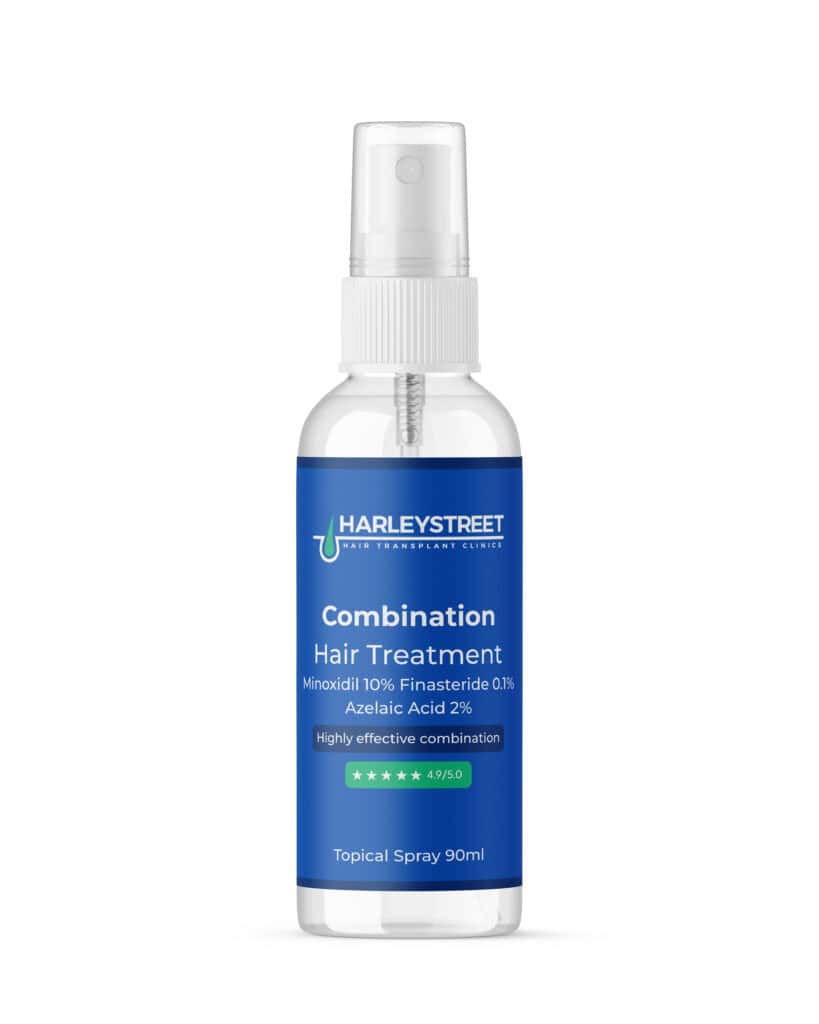





Topical finasteride is a powerful DHT-blocking medication designed to prevent hair loss caused by male pattern baldness (androgenetic alopecia). Patients choose to take topical finasteride because it is effective, minimally invasive, and free from common side effects experienced when taking oral finasteride tablets.
Key Points
- Topical finasteride for hair loss is an effective and safer alternative to oral finasteride, targeting scalp DHT locally to reduce hair thinning and promote regrowth with fewer systemic side effects.
- Clinical studies show that topical finasteride improves hair density and can be combined with minoxidil for enhanced results, especially effective in early stages of male pattern hair loss.
- In the UK, topical finasteride requires a prescription, typically available through private clinics since NHS GPs rarely prescribe it due to licensing restrictions by the MHRA.
Understanding Topical Finasteride: What Is It?
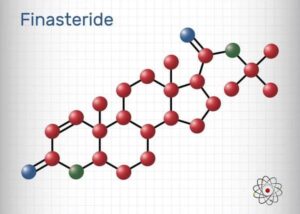 Topical finasteride is a hair loss medication designed to treat a condition called male pattern hair loss (androgenic alopecia). Similar to the tablet form, this medication works by blocking the production of dihydrotestosterone (DHT), the male sex hormone responsible for hair loss.
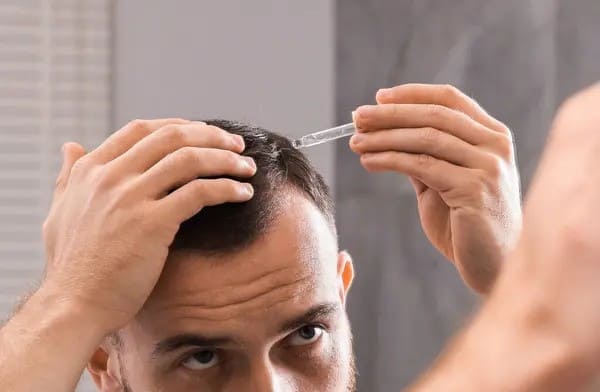
Rather than taking a tablet or pill, topical finasteride comes as a liquid solution which can be applied to the scalp. To apply topical finasteride, you should apply 1ml to your scalp once a day, and gently massage it in. Most patients tend to apply topical finasteride in the evening, so the solution can be fully absorbed overnight.
Typically, a topical finasteride solution comes at a 0.25% concentration (0.1% can also be used) and is usually mixed with a stable carrying agent, such as TrichoSol. Unlike oral finasteride, topical finasteride targets scalp DHT levels, minimising systemic side effects such as erectile dysfunction.
Topical finasteride treatment has been shown to be effective in treating male pattern hair loss, with significant improvements in hair count and hair density. It is most effective at treating early stages of hair loss (Stages 3V to 4 on the Hamilton-Norwood Scale).
This hair loss treatment is a prescription medication. This means a patient’s eligibility must be assessed by a healthcare professional. You can order your prescription online through a hair transplant clinic or a pharmacy.
How Does Topical Finasteride Work?
Topical finasteride works by blocking the conversion of testosterone into dihydrotestosterone (DHT) in the scalp, which is the hormone most responsible for male pattern hair loss. In men genetically predisposed to androgenetic alopecia, DHT causes hair follicles to shrink and miniaturise as they age.
By inhibiting the enzyme 5-alpha-reductase, finasteride helps reduce DHT levels and slows or even reverses this miniaturisation process. In our experience having treated thousands of patients, topical finasteride helps slow down temple recession and (in some instances) thicken hair on the crown area.
When applied topically, finasteride penetrates the scalp and acts locally at the site of hair loss, directly targeting hair follicles. This localised action significantly limits how much of the drug enters the bloodstream, which is one of the main reasons topical finasteride induces fewer systemic side effects compared to its oral counterpart.
By reducing DHT in the scalp, topical finasteride can help preserve existing hair, increase hair density, and in some cases, stimulate regrowth. It is most effective at stabilising hair loss on the crown and mid-scalp, though early hairline loss may also respond if treatment is started promptly. The sooner patients start to take finasteride, the more effective it is!
Does Topical Finasteride Work for Hair Loss?
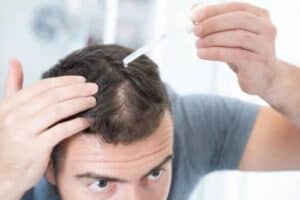 Yes, early studies and real-world evidence suggest that topical finasteride for hair loss is effective. It helps reduce DHT levels in the scalp and may slow or stop the progression of hair thinning. Many users often report visible improvements in the density and thickness of their remaining hair follicles after around 4-6 months of consistent use.
In a study conducted by the Journal of the European Academy of Dermatology and Venereology (2021), results showed “topical finasteride significantly improves hair count compared to placebo and is well tolerated. Its effect is similar to that of oral finasteride, but with markedly lower systemic exposure and less impact on serum DHT concentrations”.
In other words, topical finasteride is incredibly effective at treating male pattern hair baldness and does not produce the same levels of negative side effects when compared to finasteride tablets (such as sexual dysfunction, lowered mood, or testicular pain).
How Long Do I Need to Use Topical Finasteride to See Results?
We recommend patients need to use topical finasteride consistently for a period of 4-6 months to begin seeing visible results. This provides enough time for the hair loss treatment to take effect and prevent further hair loss from occurring. The topical finasteride experience can be split into four common phases:
- 0-3 Months: some users may notice increased shedding of their hair follicles during the first few weeks of use. This is temporary and known as “shedding phase” (telogen effluvium), which is a sign the treatment is stimulating new hair growth cycles. There will not be any visible signs of hair regrowth yet, but the medication is starting to work on reducing scalp DHT levels. It’s totally normal to be a bit sceptical early on!
- 4-6 Months: at this point, many patients will begin to see a reduction in hair shedding, stabilisation in hair loss, and a mild thickening of their existing hair follicles. A small number of topical finasteride users will also see new vellus (fine) hairs starting to appear, especially at the crown.
- 7-12 Months: significant and visible hair regrowth will become apparent with consistent use. Patients often report their hair to feel denser and thicker, especially on the crown.
- 12 Months +: the full benefits of topical finasteride typically peak at around 12 months. However, it’s important to say that continued use is necessary to maintain results. If you stop using the medication, hair loss will likely resume over time. So, consistency is key!
Can Topical Finasteride Regrow My Hairline and Crown?
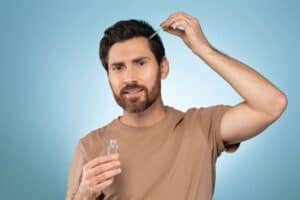 Yes, topical finasteride can potentially help regrow hair at both the hairline and crown, although the degree of regrowth varies depending on factors such as the stage of hair loss, how consistently the treatment is used, and the individual response from each patient.
The crown (or vertex) tends to respond the best to topical finasteride. According to clinica research, this area has a lower concentration of androgen receptors, making it more responsive to DHT reduction. Best results are when combined with minoxidil in order to increase the blood flow to that area as crowns tend to have less blood supply than the hairline.
When it comes to the hairline, results are a little more unpredictable. This region of the scalp has more androgen receptors and tends to be more resistant to treatment, especially if hair loss has progressed significantly. That said, some topical finasteride users have reported improvements at the hairline, particularly when they start treatment early and use it consistently.
Are Topical DHT Blockers Safe?
Topical DHT blockers are considered a safe medication for combating male pattern hair loss. They are a clinically proven alternative to oral finasteride with minimal systemic side effects. Topical finasteride is well-tolerated, with few side effects reported, such as skin irritation and allergic reactions.
As topical finasteride is applied locally to the scalp, this enables a user to target hair follicles while minimising much of the drug enters your bloodstream. If you’re worried about the side effects of DHT blocking medication, book in for a free consultation today!
Effectiveness of Topical Finasteride
 Topical finasteride has been clinically proven to be effective in treating male pattern hair loss, with significant increases in hair count and hair density. We’ve reviewed the scientific literature so you don’t have to! So, what does it say?
Research into the efficacy and safety of oral finasteride has been taking place for decades now, supporting the use of DHT-blockers (more broadly) to treat hair loss. Although long-term data for topical finasteride is still emerging, many dermatologists now recommend it as a first-line or second-line option for treating male pattern baldness.
Do Scientific Studies Support the Use of Topical Finasteride For Hair Loss?
Yes, scientific studies support the use of topical finasteride in treating hair loss. In a systematic review by the Journal of Drugs and Dermatology (2018), results on men, women, and animals consistently showed topical finasteride treatment to produce significant hair regrowth benefits with reduced side effects relative to oral finasteride. Though study designs and concentrations varied, the overall trend favoured efficacy in slowing hair loss and promoting regrowth, especially with formulations around 0.1–2%.
In recent years, a new comprehensive review highlighted that although only oral finasteride and topical minoxidil have formal FDA/EMA approval, topical finasteride stands out as a promising emergent therapy. According to Keerti (2023), early clinical data suggest good efficacy and tolerability, underscoring the need for more robust long-term studies on optimal dose, regimen, and safety profile.
So, Studies have shown that topical finasteride can promote hair growth, reduce hair loss, and improve hair density in men with androgenetic alopecia.
Topical Finasteride vs Oral Finasteride: What is the Difference?
Topical finasteride compared to oral finasteride has shown similar effectiveness in treating hair loss, but with fewer systemic side effects. This is based on clinical evidence that showed (Gupta: 2022) comparable improvements in hair density between oral finasteride and topical finasteride.
In this double-blind, randomized clinical trial involving 45 men with androgenetic alopecia, participants were split into two groups of roughly equal size. One group used a 1% topical finasteride gel twice daily and took placebo tablets, while the other took 1 mg oral finasteride daily and used a placebo gel. The study’s primary goal was to compare changes in hair density, hair thickness, and bald area coverage between the two groups over six months.
By the end of the treatment period, both groups demonstrated significant improvements in total hair count, terminal (thicker) hair count, and reduction of bald spot area. Importantly, no statistically significant differences were observed between topical and oral finasteride for any of these measures—suggesting that, in this study, the 1% gel was just as effective as the oral pill.
Results also showed that the topical group experienced notably less systemic absorption and fewer hormonal side effects than the oral group. So, the main difference between the two forms of treatment is the potential incursion of side effects in oral finasteride.
Can I Combine Topical Finasteride With Minoxidil?
The combination of topical finasteride and minoxidil has been shown to be more effective than using either treatment alone, promoting hair growth and reducing hair loss. This is supported by a scientific study conducted by Suchonwanit (2018).
In this study, researchers conducted a randomized, double-blind trial comparing a combination topical formula (0.25% finasteride + 3% minoxidil) against 3% minoxidil alone over 24 weeks in men. The combination treatment showed significantly greater total hair density gains than minoxidil monotherapy (P < 0.02).
By the end of the six-month treatment period, the group using the combination of minoxidil and finasteride showed significantly greater improvements in hair growth compared to the group using minoxidil alone. Clinical measurements revealed that the combination group experienced a more substantial increase in total hair density, and the hair that did grow was also thicker in diameter.
These findings indicated not only more hairs but also a reversal of miniaturization—the hallmark of androgenetic alopecia. Trichoscopic imaging of the scalp confirmed these observations, showing denser follicular units and fewer miniaturized hairs in the combination group.
Safety of Topical Finasteride For Hair Loss
Topical finasteride is generally safe and well-tolerated, with few side effects reported, such as skin irritation and allergic reactions. For a complete breakdown, see our dedicated topical finasteride side effects guide. Unlike oral finasteride, topical finasteride has a lower risk of systemic side effects, such as erectile dysfunction and decreased libido.
While most men are safe to take this medication, pregnant women and children should avoid handling topical finasteride, as it can cause harm to the male foetus.
Is Topical Finasteride Safer Than Oral Finasteride Tablets?
In terms of side effects, topical finasteride is generally safer to take than oral finasteride tablets. It’s difficult to say exactly how much safer one medication is over another. However, one of the key distinctions lies in how each formulation affects systemic dihydrotestosterone (DHT) levels. Oral finasteride at a dose of 1 mg daily typically reduces serum DHT levels by approximately 60 to 70 percent.
In contrast, topical finasteride at a concentration of 0.25% has been shown to lower serum DHT by only about 25 to 35 percent, depending on the formulation and how you apply the medication. This suggests that topical application results in roughly 50 percent less systemic DHT suppression, which directly relates to a lower likelihood of systemic side effects such as sexual dysfunction.
Systemic absorption also differs markedly between oral and topical finasteride. One clinical study (Piraccini: 2023) found that topical finasteride leads to over 100-fold lower systemic exposure compared to oral finasteride. In Lehmann’s terms, significantly less of the drug enters the bloodstream when applied topically, which greatly reduces the chances of affecting tissues outside the scalp.
Given this, it’s unsurprising that patients who take topical finasteride report fewer side effects, particularly related to related to sexual health. Oral finasteride is commonly associated with sexual side effects (like reduced libido and erectile dysfunction) in approximately 1.8 to 3.8 percent of users.
However, clinical trials of topical finasteride report these effects in less than 1 percent of users, a rate that is often statistically indistinguishable from placebo groups. So, if you don’t want to take oral finasteride because of the side effects, then you may want to try this hair loss treatment in topical form!
Does Topical Finasteride Affect the Liver?
Topical finasteride is very unlikely to affect the liver because its systemic absorption is minimal, especially compared to oral finasteride. Although, it’s important to note that cases of oral finasteride are extremely rare!
In tablet form, oral finasteride is absorbed into the bloodstream and passes through the liver, where it is extensively metabolised before being excreted. This hepatic (liver) processing is what raises concerns about potential liver effects with oral finasteride. Although there is no clinical evidence showing a link between liver damage and oral finasteride, it remains a concern for a small number of people who are considering taking the medication.
As topical finasteride is applied locally to the scalp, there is minimal systemic absorption, meaning it does not pose a risk to your liver. In the studies conducted to date, no cases of liver toxicity or abnormal liver enzyme levels have been reported with topical finasteride.
Can I Buy Topical Finasteride in the UK?
Yes, you can buy topical finasteride in the UK. It is a prescription medication, meaning you need a medical assessment (like a medical history questionnaire or consultation) and clinical justification (a medical reason to take it).
Can a GP Prescribe Topical Finasteride?
In the UK, most NHS GPs will not prescribe topical finasteride. This is primarily because topical finasteride is not licensed by the MHRA (Medicines and Healthcare products Regulatory Agency), which means it hasn’t been officially approved for general medical use through the NHS.
The NHS typically restricts prescriptions to licensed medications, particularly when the condition being treated (such as male pattern hair loss) is considered non-essential. Essentially, because hair loss isn’t going to kill you!
So, what does this mean for a patient who wants to take topical finasteride to combat their hair loss? In practical terms, if you’re interested in using topical finasteride in the UK, you will likely need to go through a private route. This can include visiting a private GP, dermatologist, or hair transplant clinic.
These services will assess your medical history and hair loss pattern, often through a questionnaire and photo submission, before issuing a prescription. The medication is then compounded and delivered through a partner pharmacy, and you pay privately for both the consultation and the treatment.
Conclusion
To offer some concluding remarks, topical finasteride is a fantastic treatment option for men experiencing hair loss, combining both efficacy and safety! By targeting DHT locally within the scalp, topical formulations help preserve existing hair and stimulate regrowth, especially when started early and used consistently.
Topical finasteride for hair loss is supported by a raft of clinical evidence. It has been shown to reduce hair thinning, increase hair density, and slow progression of androgenetic alopecia, all while minimising systemic side effects commonly associated with oral tablets. Additionally, combining topical finasteride with minoxidil can further enhance hair regrowth outcomes.
- European Academy of Dermatology and Venereology (2021) ‘Efficacy and tolerability of topical finasteride in male androgenetic alopecia: a randomized, placebo-controlled trial’, Journal of the European Academy of Dermatology and Venereology. Available at: https://doi.org/10.1111/jdv.17154 (Accessed: 6 June 2025).
- Gupta, A.K. et al. (2022) ‘Comparison of topical versus oral finasteride in androgenetic alopecia: A randomized, double-blind clinical trial’, Dermatologic Therapy. Available at: https://doi.org/10.1111/dth.15400 (Accessed: 6 June 2025).
- Suchonwanit, P., Thammarucha, S. and Leerunyakul, K. (2018) ‘Combination of topical minoxidil and finasteride versus topical minoxidil monotherapy in male androgenetic alopecia: a randomized controlled trial’, Journal of Dermatological Treatment, 29(7), pp. 702–707. Available at: https://doi.org/10.1080/09546634.2017.1415714 (Accessed: 6 June 2025).
- Piraccini, B.M. et al. (2023) ‘Pharmacokinetics and systemic exposure of topical finasteride compared to oral finasteride in men with androgenetic alopecia’, Clinical Pharmacology & Therapeutics. Available at: https://doi.org/10.1002/cpt.2820 (Accessed: 6 June 2025).
- Keerti, S. (2023) ‘Topical finasteride in androgenetic alopecia: a review of efficacy and safety’, Dermatologic Clinics, 41(2), pp. 239-245. Available at: https://doi.org/10.1016/j.det.2022.10.003 (Accessed: 6 June 2025).