





Follicular Unit Extraction (FUE) and Direct Hair Implantation (DHI) are minimally invasive methods of a hair transplant procedure. If you’re looking at getting a hair transplant, then you will definitely have heard of them! In this article, we’ll walk you through both procedures, their similarities and differences, as well as their recovery times and efficacy.
Key Points
- FUE and DHI are both modern, minimally invasive hair transplant techniques that move healthy hair from the donor area to receding hairlines and thinning crowns. It is also possible to perform beard transplants and eyebrow transplants using both methods.
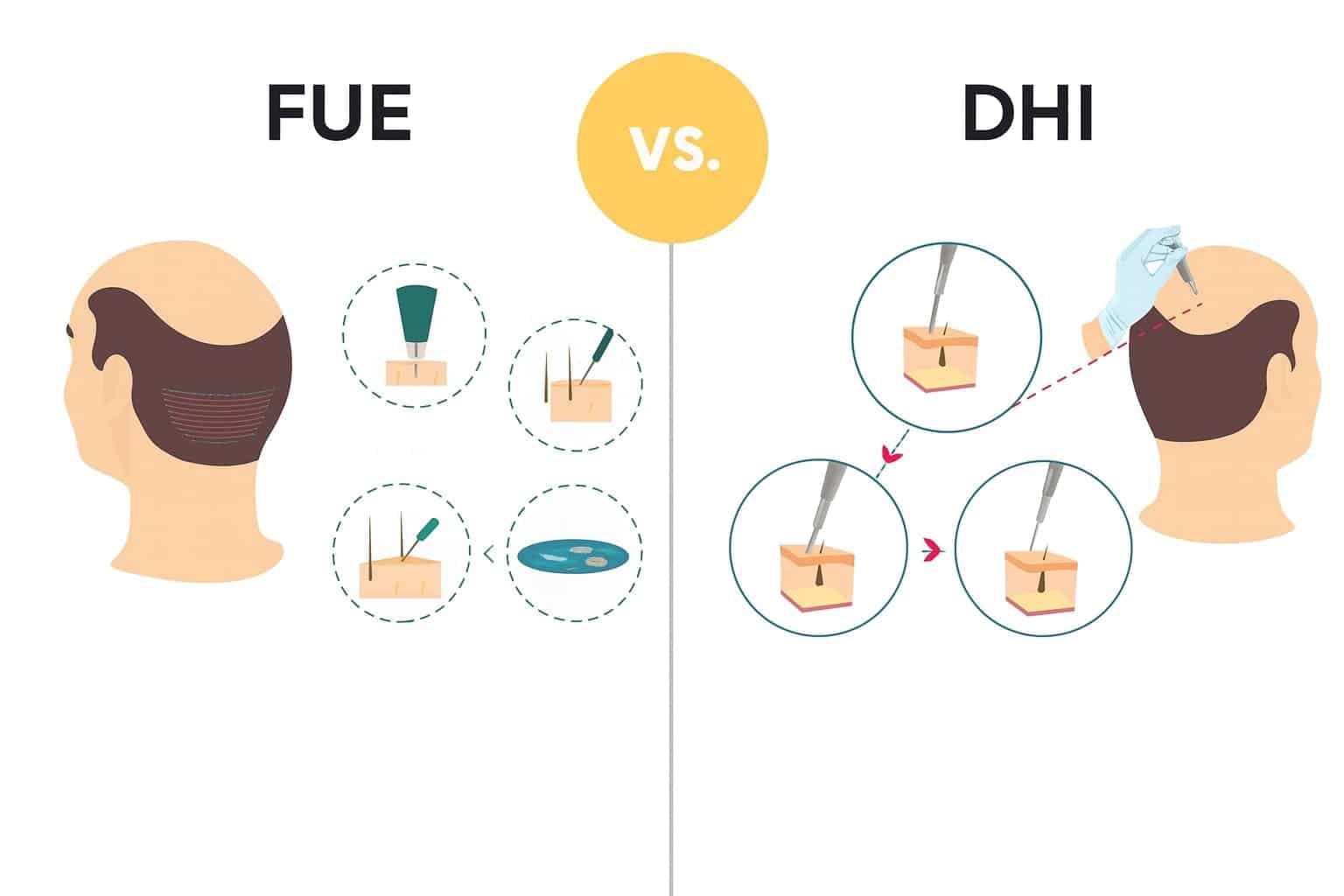
- The main difference is in implantation: FUE creates tiny incisions before inserting grafts, while DHI uses a special CHOI implanter pen to insert hair directly into the scalp in one motion.
- Both methods help deliver natural results, but FUE is typically more cost-effective and suited for larger areas, whereas DHI offers greater precision for smaller, detailed transplants like hairlines or temples.
FUE vs DHI – What’s the Main Difference ?
 For anyone conducting the initial stages of research into a hair transplant, the difference between FUE and DHI can be quite confusing. In short, it all comes down to incisions and implantation. Here’s a quick summation:
- FUE requires the surgeon to create incision channels before using special forceps to implant the hair follicles into the transplant site.
- DHI combines the incision and implantation phase using a special pen that implants grafts directly to the scalp.
Both techniques involve taking individual hair grafts from a donor area, but the way those grafts are inserted into the thinning or bald areas is what sets them apart.
In an FUE hair transplant, the process happens in two distinct stages. First, the surgeon or technician creates tiny channels or incisions in the recipient area of the scalp. Then, the harvested hair grafts are manually placed into those pre-made channels using fine forceps or implanter tools.
With DHI, the implantation step is more streamlined. Instead of first making channels and then inserting grafts, the surgeon uses a specialised tool called a “CHOI implant pen”. This device allows them to load each graft into the pen and implant it directly into the scalp in one motion, simultaneously creating the channel and inserting the hair.
FUE vs DHI Recovery Time
In terms of recovery, both FUE and DHI are minimally invasive, meaning that a patient’s scalp will heal reasonably quickly. For both methods, the initial recovery period is around 14 days. During this time, patients need to follow aftercare instructions, as well as rest and recuperate after their surgery.
Some clinics online state that DHI requires a shorter recovery time of 10-14 days, while FUE requires the full 14 days. At Harley Street HT Clinics, we have found that recovery is more dependent upon each patient’s individual response to scabbing and swelling than any method used.
With both procedures, we recommend all patients take 2 weeks off work (or remote work), as this ensures enough time for grafts to bed in, chances of infection to be minimised, and scabs to form and fall off.
Sapphire FUE vs DHI
 Both techniques are technically considered to be part of the Follicular Unit Extraction method. The key difference with DHI vs Sapphire FUE is that it refers to the implantation part only. So with sapphire FUE, the blades are used to make the incisions which the follicles will then be implanted. With DHI, a special tool called the CHOI implanter pen is used to place the follicles inside the pen which is then inserted into the skin of the recipient area and the follicle is then “loaded in”.
Sapphire FUE tends to be used for larger areas of hair loss as the speed of implantation is quicker due to having 2-3 technicians working on a case vs DHI where there is only 1 person doing the implantation at any given time.
One of the main reasons why people would choose DHI over Sapphire FUE would be that with DHI, the recipient area doesn’t need to be shaved even if it’s thinning. The main disadvantage is that smaller areas can be worked on at once meaning that the cost is much higher if a patients has a large area of hair loss and so would require multiple DHI surgeries.
FUE vs DHI Cost
The difference in cost between FUE and DHI is typically +£1,000 more for a DHI hair transplant. The main 2 reasons are:
- Cost of tools. The implanter pens cost a lot more than the FUE blades which makes the cost of the procedure more expensive
- The time taken to perform the procedure is longer when comparing to FUE.
Because of these factors, an overview of the comparison of costs and graft numbers is:
- 1,000 grafts FUE = £4,000 vs 1,000 grafts DHI = £5,000 roughly
- 1,500 grafts FUE = £5,000 vs 1,500 grafts DHI = £6,000 roughly
- 2,000 grafts FUE = £5,500 vs 2,000 grafts DHI = £6,500 roughly
- 2,500 grafts FUE = £6,000 vs 2,500 grafts DHI = too high graft numbers. Limited to up to 2,000 grafts per procedure.
FUE vs DHI vs FUT
The main difference is the extraction method when comparing all techniques side by side. Both FUE and DHI use the same methodology for extracting the grafts from the donor area whereas the FUT method extraction is by surgical excision of a strip of skin to then harvest the grafts. Technically a FUT procedure can also involve the DHI element as the extraction could be done as usual and then when it comes to implantation, implanter pens can be used which would make the implantation method, DHI.
The top consideration between these 3 methods is the donor area vs the size of the recipient area. If the recipient area is small to medium (say 1,000 – 2,000 grafts) and the hair is thinning, then DHI is typically very appropriate. If the area is larger (say 2,000 – 3,000 grafts), then FUE or FUT can both be appropriate. If the area is much larger (say 4,000 – 5,000 grafts) and the donor area isn’t very thick, a combo of FUT and FUE may be best suited in order to cover the recipient area as much as possible but not thin the donor area out too much via 2 FUE procedures.
FUE or DHI – Which Hair Transplant Method Is Better?
It’s difficult to say which of these two hair transplant procedures is “better” than the other. It depends on each patient’s aims and expectations around result, recovery time, and price.
For the vast majority of cases, FUE provides a hair transplant surgeon with plenty of options. The method offers flexibility when covering large bald areas and is efficient for transplanting thousands of grafts in a single session.
However, because the grafts spend more time outside the body (in a saline solution), and because channel creation and implantation are separate steps, precision in angle and depth relies heavily on the surgeon’s skill. So, it’s vital you meet your surgeon and have a look at their work before making your final decision.
Many of our patients do enquire about the possibility of a DHI hair transplant. The advantage of this method is greater control over the angle, depth, and direction of each implanted hair, which can lead to a more natural-looking result, especially for the hairline or smaller, detailed areas. However, it does come at a slightly higher cost than traditional FUE.
At Harley Street Hair Transplant Clinics London, all of our surgeons have decades of experience, not only being GMC-registered, but members of the International Society of Hair Restoration Surgery (ISHRS). They’ve performed thousands of surgeries, so why not book a free consultation and get your treatment plan today?
Conclusion
Both FUE and DHI are highly effective, surgeon-led procedures that can restore natural-looking hair growth with minimal scarring and downtime. The key difference lies in technique and precision rather than overall success rates.
FUE remains the most popular option due to its versatility, efficiency, and affordability, making it ideal for patients with more extensive hair loss. DHI, on the other hand, is a refined version of FUE that provides meticulous control over angle and direction—perfect for smaller, detail-focused procedures where artistry and accuracy matter most.