




If you’re researching hair transplants, you’ve likely come across two main techniques: FUE (Follicular Unit Extraction) and FUT (Follicular Unit Transplantation). While both methods aim to restore natural hair growth, their process, recovery, and results vary slightly. In this article, we’ll break down FUE vs FUT, helping you understand which option is better for your hair loss type.
Overview
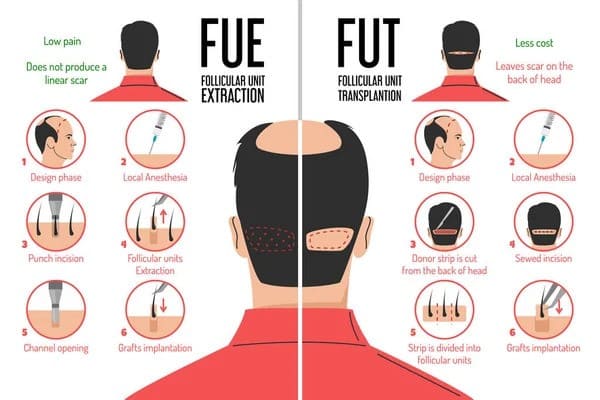
- The main different between FUE and FUT is the method of extraction. With FUE, each individual hair graft is extracted whereas with FUT a strip of skin is excised and then hairs are harvested
- FUE is more popular than FUT because of the lack of visible scarring due to the small instrument used to extract the follicles vs a large linear scar which an FUT leaves behind in the donor area.
- FUT can be more expensive as more technicians are needed to cut and extract the grafts from the excised strip of skin.
- FUT is typically better suited to women or transgender that don’t want to shave their donor area vs FUE where the donor area has to be shaven
What are the main differences between FUE and FUT?
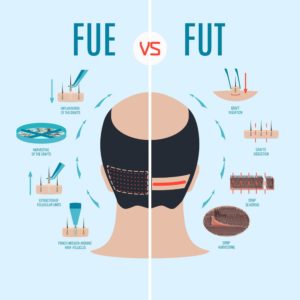 The main different is in the extraction process. Simply put, FUE is a more labour intensive process when performing the extraction part as each individual graft is taken out one by one whereas with FUT, there is a large strip of skin that is excised and the technicians can work on dissecting the grafts whilst the surgeon is making incisions to make the procedure more efficient and quicker.
Most other things during the procedure are the same such as the local anaesthetic injections, the incisions created, the implantation method and most of the aftercare.
| Feature | FUE | FUT |
|---|---|---|
| Graft Extraction Method | Individual follicles | Scalp strip |
| Scarring | Tiny dots | Linear scar |
| Recovery time | 7-14 days | 10-14 days |
| Procedure duration | 6-9 hours | 4-8 hours |
| Pain after surger | Very mild | Moderate |
| Cost per graft | £2.75 | £3 |
| Best for | Short hair, minimal scarring | High graft needs and longer hair |
Which method leaves more scarring, FUE or FUT?
Both methods leaves scars. The question to ask would be which method leaves the more visible scarring. The answer is that IF the hair was cut short at the back and sides, the FUT method without a doubt would leave a more visible horizontal linear scar as opposed to the FUE method that leaves lots of small dot scars that aren’t nearly as visible as the FUT scar.
To summarise:
FUT leaves a linear scar across the donor area. This becomes visible with short haircuts.
FUE leaves tiny round scars dispersed across the scalp, often invisible to the naked eye.
Scar visibility:
FUT: Visible under 5 mm hair.
FUE: Often hidden under 1 mm hair.
Which hair transplant technique is more painful FUE or FUT?
Generally speaking, the FUT technique tends to be the more painful one as it’s a much more invasive procedure than FUE due to the large strip of skin that is cut out. To summarise:
FUT can cause more post-op discomfort due to sutures.
FUE generally involves less pain and tension.
- Anaesthesia: Local for both.
- Pain scale: FUT (4–6), FUE (2–4)
- Common meds: Ibuprofen, antibiotics, corticosteroids.
Which offers better results: FUE or FUT ?
Both methods produce permanent, natural-looking results when performed by experienced surgeons.
- FUT offers slightly higher graft survival rates due to less trauma to the grafts.
- FUE produces less scarring and faster and less painful recovery times.
- Long-term density: Comparable if the graft count is matched.
Example:
- FUE is preferred for frontal hairline aesthetics.
- FUT is preferred for maximum graft harvesting in one session.
What are the costs of FUE vs FUT?
The costs are generally very similar depending on the size of the case. FUT tends to be more expensive because there is an extra technician usually that is needed in order to work on the excised strip of skin to dissect, count and categorise the grafts. With FUE, the extra technician isn’t needed as, in essence, the process has already been done because the extracted grafts are presented to the technicians one by one individually.
To give you an idea:
- The cost per graft for an FUE hair transplant is between £2.10 and £5.60 depending on the size of the procedure.
- The cost per graft for an FUT hair transplant is between £2.50 and £6.30 depending on the size of the procedure.
Who should choose the FUE method?
FUE is ideal for people that don’t mind shaving their donor area, want non visible scarring, want a non invasive procedure, want a quick recovery with a small amount of downtime and those people that typically have their hairstyle short, such as the fade as that exposes a lot of the donor area. Most of our FUE procedures are done on men that have hairline hair loss or crown hair loss.
Who should choose the FUT method?
FUT is ideal for people that don’t want to shave their head, are typically female, don’t have a thick/dense donor area and those that typically leave their hair long in length.
What are the risks and complications?
There are common risks for both procedure types and also risks that are isolated to each. The common risks are:
- Infection – <1%
- Graft failure. 2-10%
- Shock loss: temporary hair shedding.
- Numbness – usually subsides within 2-4 weeks.
FUE specific risks:
- Overharvesting of the donor area.
- Uneven extraction pattern.
- Follicle transection – in essence too much follicle damage.
FUT specific risks:
- Scar stretching.
- Suture discomfort.
- Higher risk of infection.
- Slower recovery.
How do recovery times compare with both FUE and FUT?
Both procedure types have very similar recoveries if all goes well. The fut technique will have a longer period of healing, and thus, recovery time due to the larger open wound that takes longer to heal vs small dot wounds.
In terms of some common factors, the timings are very similar. Examples:
- Both FUE and FUT need 12 months to see the final results
- With both you need 14 days recovery time before you can do some very light exercise. With FUT you will require longer (around 1 month) before you can exercise as normal, whereas with FUE you need less time (around 2 weeks).
- With both you can return to work at the same time (depending on what you do for work).
- There is visible swelling after a hair transplant that lasts the same amount of time with both procedure types. Around 2-5 days.
What do our surgeons recommend?
Our surgeons are FUE surgeons and so will always recommend FUE. We also do recommend FUT when an appropriate patient arrives. This will depend on the same factors as discussed above. There have also been times when a patient that is perfectly fine for FUE simply doesn’t want to shave his donor area and opts to go down the FUT route. Our surgeons will always recommend what is best for the patient.
What do patients say about FUE vs FUT?
Patients echo our sentiments above. FUE testimonials often highlight the following:
- Less visible scarring.
- Shorter downtime.
- Easier healing.
FUT patient report:
- Happy to not shave their donor area.
- Slightly more discomfort and pain.
- Effective large graft number sessions.
Survey data:
- FUE satisfaction is at 93%
- FUT satisfaction is at 87%
How to choose between FUE and FUT?
This is a personal choice and based on all the information above, you should ask yourself the following:
- Do I need maximum graft numbers of minimum visible scarring?
- Can I afford a longer downtime and healing time?
- Am I OK with a visible scar when my hair is short at the back?
Checklist for a consultation:
- Ask about graft survival rates.
- Review before and after images.
- Confirm GMC certified surgeons qualified to perform hair transplant.
FAQs
Yes, hybrid transplants allow higher graft counts in one or multiple sessions via a single FUE and FUT combo or a 2 session split with one procedure on 1 session and the other on the 2nd session.
Not really. It remains a necessity for certain patients that just don’t have a good enough donor area to merit having FUE and for women mostly that don’t want to shave the back of their head as they have had long hair for the majority of their life.
Yes, FUE can be used for beard, chest and general body hair transplants, although the first choice would be scalp donor hair as the texture and quality of that hair vs body hair is different.
FUE and FUT results are permanent and should last a lifetime as the hairs are taken from the DHT resistant zone. See how long does a hair transplant last for more information.
No, both procedure types yield permanent results if grafts are taken from a stable donor area.