






Vitamin B12 is vital for the body’s red blood cell production, DNA synthesis, as well as maintaining neurological and metabolic health. Being deficient in vitamin B12 has serious side effects, including hair loss. In this article, we’ll break down the link between vitamin B12 deficiency and hair loss, and outline what you need to do to encourage healthy hair growth.
Key Points
- Vitamin B12 is essential for healthy hair growth – it supports DNA synthesis, red blood cell formation, and cell metabolism. The processes are vital for maintaining the hair growth cycle and nourishing the follicles.
- Deficiency can contribute to diffuse hair shedding – while B12 deficiency alone rarely causes baldness, it can trigger or worsen telogen effluvium-type hair loss, especially in those with restrictive diets or absorption issues.
- Testing and treatment are crucial – identifying and correcting low B12 levels through diet, supplementation, or medical treatment can help restore balance and support regrowth, but results take time and depend on addressing all underlying factors.
What is Vitamin B12 and Why is it Important For Our Hair?
Hair loss is one of those dreaded aesthetic issues: frightening, personal, and often mysterious. While there are many potential causes of hair loss (e.g. genetics, hormones, autoimmune conditions, stress), nutritional deficiencies can often fly under the radar.
Today, we’re going to focus on one specific nutrient: Vitamin B12 (cobalamin), and ask the question: “can vitamin B12 deficiency cause hair loss? If so, how strong is the evidence, what are the mechanisms, what should you do about it, and when is it just another red-herring?
Vitamin B12 (Cobalamin): What is it?
Vitamin B12, also known as cobalamin, is a water-soluble vitamin that your body needs in small but essential amounts. It plays a major role in:
- Red blood-cell production – without enough B12, red blood cells become large and irregularly shaped, leading to anaemia and fatigue.
- DNA synthesis – every cell that divides, especially rapidly growing cells like those in your hair follicle, requires B12 to replicate DNA properly.
- Neurologic health – B12 helps maintain the myelin sheath around nerves, essential for normal brain and nerve signalling.
- Metabolic processes – it works alongside other B vitamins to convert food into usable cellular energy.
 Unlike a lot of other vitamins, B12 is not produced by plants. It is made by certain bacteria and accumulates in animal foods. Rich sources of vitamin B12 includes: mean, fish and seafood, dairy products, and eggs.
For people following vegan or vegetarian diets, or those with digestive or absorption issues (like pernicious anaemia or Crohn’s disease), getting enough B12 can be challenging. As such, we tend to see a lot of patients with restrictive diets and digestive problems reporting hair loss symptoms. In such cases, supplementation (through tablets, sublingual drops, or periodic injections) may be necessary.
Vitamin B12 and Hair Growth: What’s the Link?
In the context of hair health, vitamin b12 plays quite an important role. Especially in maintaining the hair growth cycle. This is the case for a couple of reasons:
- Hair‐follicle cells are among the most rapidly dividing cells in the body (during the anagen or growth phase of the hair growth cycle). DNA synthesis, cell division and metabolic support are crucial. B12 helps with nucleic-acid production and cell replication.
- Hair follicles need a healthy blood supply to receive enough oxygen and nutrients. B12 is necessary for red blood-cell formation and, by extension, healthy circulation. Some sources point to reduced oxygenation of the follicle when B12 is deficient.
- Nutrient deficiencies often tend to produce diffuse hair thinning rather than sharply demarcated patterns of baldness (e.g. male and female pattern baldness). So if B12 has a role, we’d expect diffuse shedding or telogen effluvium-type presentation.
Scientific theory shows vitamin b12 to play an important role in hair health. Further still, when patients don’t get enough of this vitamin, many experience symptoms of diffuse hair loss. But what does the clinical evidence say?
What Does the Science Say About Vitamin B12 and Hair Loss?
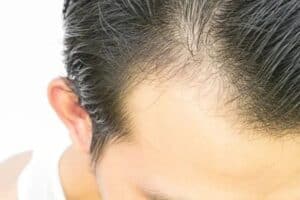 Scientific research has shown a strong link between vitamin b12 deficiency and hair loss. In a 2018 study, researchers found that out of all possible B vitamin deficiencies, only riboflavin (B2), biotin, folate, and B12 deficiency were associated with hair loss (1).
Furthermore, in a study of participants experiencing chronic telogen effluvium (diffuse hair shedding), testing showed that 60% also were deficient in vitamin b12. That was significantly higher than the control group, of which only 26% had vitamin b12 deficiency (2).
So, there is a strong correlation between low vitamin b12 levels and diffuse hair shedding. However, the evidence is hardly overwhelming and does not prove causation in all cases. This means that vitamin b12 can be a contributor to hair loss, but it is rarely the only factor.
If you’re already suffering from a condition like androgenetic alopecia or alopecia areata, then vitamin b12 deficiency may worsen pre-existing hair loss symptoms.
Does Vitamin b12 Deficiency Cause Hair Loss?
When it comes to hair loss and nutritional deficiencies, we need to be really precise in how we phrase things to not be misleading. Here are some key things to consider:
- Cause vs Contributor – because hair-loss is multi-factorial, b12 deficiency is probably best viewed not as a stand‐alone cause in most cases (unless severe), but as a contributory factor.
- What Condition Are You Experiencing? – the evidence suggests b12 deficiency is more linked with diffuse hair thinning / telogen effluvium-type shedding rather than pattern baldness.
- Absorption/malabsorption counts: Many b12 deficiencies arise not strictly from inadequate intake, but from malabsorption (e.g., pernicious anaemia, gastrointestinal surgery, vegan diets with long-term low intake). In these cases, the hair‐finding may be more subtle or delayed.
- Absorption/malabsorption counts – many b12 deficiencies arise not strictly from inadequate intake, but from malabsorption (e.g., pernicious anaemia, gastrointestinal surgery, vegan diets with long-term low intake). In these cases, the hair‐finding may be more subtle or delayed.
Therefore, if you have documented B12 deficiency plus unexplained diffuse hair shedding, addressing B12 is absolutely warranted. But if you simply have hair loss and normal B12 levels (or borderline levels without other symptoms), then B12 is unlikely to be the sole culprit.
How Can I Assess If Vitamin b12 Deficiency May Be Responsible For My Hair Loss?
If you’re wondering whether b12 could be playing a role in your hair loss, here’s a checklist of red-flags to help you on your way:
- You have other signs of B12 deficiency: fatigue, pallor, tingling or numbness in hands/feet, smooth or sore tongue, neurological symptoms, shortness of breath.
- You follow a restrictive diet (e.g. vegan/vegetarian) for many years, low in animal-products (the main source of B12). Or you have history of gastrointestinal disease, surgery (gastric bypass, ileal resection), long-term use of proton-pump inhibitors, or known malabsorption.
- You have unexplained, diffuse hair shedding. This could be visible through more hair coming out while you shower the shower, brush your hair, etc. It is more likely to be coming our in clumps, rather than localised hair loss on the frontal hairline or temples.
- You have low or borderline B12 serum values (depending on local lab values) and/or elevated biomarkers (methylmalonic acid or homocysteine) if tested.
If you are experiencing the following symptoms, then it is important to get an accurate diagnosis. We don’t offer a diagnosis service at Harley Street HT Clinics. So, you will need to contact your local GP and ask for a blood test. You should test for the following blood markers:
- Full blood count (to test for iron deficiency anemia)
- Vitamin b12
- Thyroid panel
- Ferritin
- Zinc
- Vitamin D
What Can I Do If My Vitamin b12 Levels are Low?
 If your B12 is low and you also have hair shedding, here’s a practical roadmap to get you on the road to recovery:
The first step is to make sure you are getting enough vitamin b12 in your daily diet. So, increase your intake of b12-rich foods. Eat plenty of meat, fish, eggs, and dairy. If you are a vegan, you may want to consider introducing eggs into your diet or a dietary supplement.
Oral supplements are also a great option to make sure you are hitting your daily vitamin b12 levels. Alternatively, if your deficiency is due to malabsorption, then you may need intramuscular injections.
Can a Vitamin b12 Deficiency Affect My Hair Transplant?
It may be the case that vitamin b12 deficiency can affect your hair transplant. In the past, we have performed surgeries on a small number of patients, whose results have been sub-optimal. During follow up consultations, poor hair growth and increased shedding post-procedure has been linked to a low-protein, vegan diet.
So, if you are considering a hair transplant, you may want to make sure you are not deficient in any vitamins or minerals as this can have a detrimental effect on your final result. At the heart of any hair transplant should be healthy hair growth.
Conclusion
Vitamin B12 plays a clear biological role in supporting strong, healthy hair. While a deficiency doesn’t always cause hair loss directly, it’s an important contributing factor. Especially, when combined with other stressors or nutrient deficiencies. If you’re noticing diffuse hair thinning, fatigue, or other signs of B12 deficiency, it’s worth speaking with your GP to arrange a blood test.
By correcting low B12 levels, improving your diet, and addressing any malabsorption issues, you create the best environment for hair to recover naturally. Ultimately, healthy hair starts from within, and ensuring adequate vitamin B12 is a key part of that foundation.
- Almohanna, H.M., Ahmed, A.A., Tsatalis, J.P. and Tosti, A., 2018. The role of vitamins and minerals in hair loss: a review. Journal of Drugs in Dermatology, 17(11), pp.1161–1167.
- Mamantha, M., Kavitha, M., Chaitra, T.R., and Veeranna, S., 2022. Serum Vitamin B12 in Chronic Telogen Effluvium. Journal of Dermatology and Dermatologic Surgery, 26(2), pp.63–67.