
Hairline Hair Transplant

Area treated: Frontal hairline and temples
Typical method: Follicular Unit Extraction (FUE)
Grafts: 1,000 to 2,500 for most hairlines
Procedure time: Around 6 to 8 hours, one day
Cost: From £3,000
Anaesthetic: Local, surgeon-performed
First regrowth: Months 3 to 4
Final result: 9 to 12 months


Certifications

GMC white
CQC logo-min
ISHRSMembersOnlyLOGO-Gold without background
ICO logo

Our Certifications

GMC white
CQC logo-min
ISHRSMembersOnlyLOGO-Gold without background
ICO logo
Harley Street HT patient, Elliot hairline

A hairline hair transplant restores a receding, uneven or high hairline by moving your own DHT-resistant follicles from the back and sides of the scalp into the hairline. It is the most requested procedure at our clinic. This page explains what happens, who it suits, how a natural hairline is designed and performed, how long results last, and what it costs.
What is a Hairline Hair Transplant?

A hairline hair transplant is a procedure that rebuilds the frontal hairline by moving healthy follicles from the back and sides of the scalp into the areas that have receded. The hairline is the band of hair closest to the forehead, running from temple to temple. It is one of the first areas affected by hair loss, which is why a hairline hair transplant is the most popular procedure we perform.

The unit that is moved is called the follicular unit, a natural grouping of one to four+ hairs as they emerge from the scalp. Hairline work relies heavily on using single-hair (placed at the front) and two-hair units (placed further back), because the front of a natural hairline is made of the finest hairs. A “graft” and a “follicular unit” mean the same thing here, while the hair count is higher, so 2,000 grafts can carry roughly 4,000 to 4,500 hairs.

Those units are taken from an area of high density and placed into an area of low density. The high-density area is the donor area at the back and sides of the head, where a healthy scalp carries around 80 to 100 follicular units per square centimetre. A transplanted hairline is usually rebuilt to a lower density than that, commonly 30 to 45 units per square centimetre, which looks full because of how the frontline is designed rather than because it matches native density hair for hair.

Harley Street HT patient, Elliot hairline

Make the best investment in yourself and find out more about how we can help eliminate hair loss for good!

What causes a receding hairline

A receding hairline is usually the first sign of androgenetic alopecia, or male pattern hair loss. The driver is dihydrotestosterone (DHT), a hormone converted from testosterone by the enzyme 5-alpha-reductase. DHT binds to receptors on genetically sensitive follicles at the front and top of the scalp and shrinks them over successive growth cycles, a process called miniaturisation.

Miniaturisation happens in stages. With each cycle, the follicle spends less time in its active growth phase, so the hair it produces grows shorter, finer and lighter. Terminal hairs become vellus hairs, and eventually the follicle stops producing a visible hair at all. This is why a receding hairline thins and lightens before it clears, rather than disappearing overnight.

The pattern this produces was first described by James Hamilton in 1951 and refined by O’Tar Norwood in 1975, whose Hamilton-Norwood scale is still the standard today. A hairline typically recedes at the temples first, taking on an M shape from Stage 2 to Stage 3. Because the loss is hormonal and progressive, our surgeons plan against the male pattern baldness stages, so the design accounts for the thinning likely to appear behind the new hairline, not only the recession visible today.

Not every high hairline is pathological. A mature hairline settles back by roughly one to one and a half centimetres in the late teens and twenties, which is normal and is not the same as a receding hairline. Telling a mature hairline apart from early male pattern loss is one of the first things our surgeons assess, because it decides whether surgery is needed at all.

Types of hairline restoration

Most hairline work is one of a few types, set by where the loss sits and how far the hairline has moved. Both temple and lowering work can be done with FUE or FUT, though almost all hairline work today uses FUE.

Temple restoration fills the receded corners either side of the frontline, which is common in earlier loss, often between the ages of 25 and 35. It usually needs a few hundred grafts per side and calls for very acute angling, because temple hair grows almost flat against the skin. This is covered in full on our temple hair transplant page.

Hairline lowering brings a high or receded hairline forward to reduce the height of the forehead. As a guide, the rebuilt hairline sits around 7.5cm from the brow at the centre and 8cm at the temples, though this is set to your face, not to a fixed number. Where the forehead is being lowered rather than a receding pattern treated, the choice between grafting and surgical advancement matters, and we compare both on our hairline lowering surgery page.

A widow’s peak is the central point some hairlines carry. It can be rebuilt where it has been lost, or softened where it sits too low, and the decision is aesthetic rather than medical. We cover the design choices on our widow’s peak hair transplant page. Female hairlines are planned differently again, usually to lower or reshape a hairline that is not receding in a male pattern, which we set out on our women’s hair transplant page.

Who is a good candidate for a hairline transplant

A good candidate is a patient whose hair loss has stabilised and whose donor area can supply enough follicles for a result that still looks right in twenty years. Four factors decide suitability, and a surgeon confirms all of them at consultation.

  • Stable or controlled loss – Loss that has settled, or is held steady with medication, so recession does not continue behind the new hairline.
  • Donor supply – Enough density at the back and sides, measured for lifetime supply, to rebuild the hairline now and cover later loss.
  • Age and pattern – Old enough for the pattern to be readable, so the hairline is placed for the face you will have, not the one you had at twenty.
  • Hair characteristics – Wave, calibre and colour contrast with the scalp all affect how much coverage each graft gives.

Donor supply is the constraint most patients underestimate. The safe donor zone holds a finite number of grafts across a lifetime, often in the region of 4,000 to 6,000 usable follicular units, and every graft used at the hairline is one not available for the crown later. This is why a surgeon assesses the donor with magnification before agreeing a plan, and why a hairline is rarely rebuilt to full native density.

Timing is the factor patients most often get wrong. Surgery done too early, before loss has stabilised, risks a visible gap opening behind a transplanted hairline as native hair keeps thinning, which then needs further work. We check your stage on the Hamilton-Norwood scale, and where loss is still active we may advise holding the hairline steady with medication before operating.

Harley Street HT Pt before and after 1

How a natural hairline is designed

A natural hairline comes from design more than from graft count. The frontline is built as a soft, irregular transition rather than a straight edge, because a hard, even line is the single clearest sign of a transplant. The design is drawn with you while you are upright, agreed before anaesthetic, and cannot be changed once the area is numb, so this stage takes real time at the start of the day.

Placement of the hairline follows facial proportion. The mid-frontal point, the lowest centre of the hairline, is commonly set around 8 to 9 centimetres above the brow, then adjusted to your face shape, forehead height and the loss expected in future. Setting it too low to chase a youthful look is the most common design error, because the face keeps ageing while the low line does not.

Five details do most of the work of making a hairline read as natural.

  • A transition zone of single hairs – The first few rows use only single-hair grafts, scattered slightly irregularly, so the edge looks feathered rather than drawn.
  • Irregularity at two scales – Macro-irregularity gives the line gentle peaks and recesses, micro-irregularity breaks up the very edge, and both defeat the “wall” look.
  • Acute angle and direction – Front hairs are placed at a shallow forward angle, close to the skin, pointing the way natural hair grows, with temple hairs flatter still.
  • A density gradient – Density rises from sparse single hairs at the edge to fuller multi-hair grafts behind, so the eye reads depth rather than a front row.
  • Frontotemporal balance – The corners where hairline meets temple are set symmetrically and age-appropriately, since these frame the face.

Which technique suits a hairline: FUE, FUT or DHI

FUE suits almost all hairline work, because it takes follicles one at a time and leaves no linear scar, which matters for an area on show. The real choice is how follicles are extracted and how they are placed, and a surgeon confirms it at consultation once the donor has been assessed.

FUE, or follicular unit extraction, removes each follicular unit individually with a small punch, usually 0.7 to 1.0mm across, and leaves only tiny dot scars that hair covers. It is the default for hairlines and is explained in full on our FUE hair transplant page. FUT, or follicular unit transplantation, removes a strip of donor skin instead, which can yield a large number of grafts in one session but leaves a fine linear scar at the back of the head. It still has a role in larger cases, which we cover on the FUT hair transplant page.

Two refinements of FUE are relevant to hairlines. DHI uses an implanter pen that places each graft directly, without pre-made incisions, giving the surgeon fine control over the angle, depth and density at the frontline. Sapphire FUE uses sapphire-tipped blades to make smaller, more uniform recipient sites. Both aim at the same goal, which is dense, precise, natural placement in the most visible part of the scalp.

What happens during a hairline hair transplant

A hairline hair transplant is a single-day procedure under local anaesthetic, taking around 6 to 8 hours depending on graft numbers. You are awake throughout and feel no pain in the scalp once the anaesthetic is working. The day runs in four stages.

Design and preparation

The surgeon marks the hairline with you while you are sitting upright, takes photographs, and agrees the plan. The donor area is then trimmed and local anaesthetic is given as a ring block, which numbs the scalp for several hours and is topped up as needed.

Extraction

Extraction of the donor follicles usually takes two to three hours. Each follicular unit is removed with a fine punch and checked under magnification, then kept in a chilled holding solution until it is placed. Graft survival depends partly on how long follicles spend outside the body, so the team works to keep that time short and the grafts hydrated. Most hairlines need between 1,000 and 2,500 grafts, and you can size your own case with our hair transplant graft calculator.

Recipient sites and placement

The surgeon creates the recipient sites, which is the part that decides the result. Small incisions are made with a fine blade or implanter pen, usually between 0.7mm and 0.85mm, each set at the angle, depth and direction the final hair will follow. The prepared grafts are then placed into these sites, single-hair units along the front edge and multi-hair units behind for density. Grafts placed with FUE have a typical survival rate of 90 to 95%.

Recovery timeline after a hairline transplant

Initial healing takes 10 to 14 days, and the full result takes 9 to 12 months, because transplanted hair goes through a shedding phase before it regrows. Knowing the stages in advance removes most of the worry, since the alarming ones are normal.

  • Days 0 to 3 – Small crusts form around each graft and the area looks red. You sleep propped up to limit swelling.
  • Days 3 to 10 – Gentle washing begins on your surgeon’s schedule. Crusts soften and start to clear.
  • Days 10 to 14 – Crusts have gone and redness fades. Most patients are back to normal appearance.
  • Weeks 3 to 6 – Transplanted hairs shed. This is expected and is the follicles resetting, not a failure.
  • Months 3 to 4 – New hairs begin to break through.
  • Months 6 to 12 – Growth fills in and thickens, with the final hairline by around month 12.

The shedding at weeks three to six worries patients most, so it helps to expect it. Occasionally some weakened native hairs around the grafts shed too, called shock loss, and these usually regrow. Our hair transplant timeline sets out each month in detail. For the first two weeks you avoid the gym, swimming, alcohol, smoking and direct sun, all of which our hair transplant aftercare guidance explains and why each one matters.

How long hairline transplant results last

Transplanted hairline follicles are permanent. They come from the DHT-resistant donor zone at the back and sides and keep that resistance after they are moved, a principle called donor dominance, established by Norman Orentreich in 1959 and still the basis of the procedure. The transplanted hairline itself does not recede.

What can change is the untreated native hair around and behind the new hairline, which may keep thinning with age. Loss can also progress backward to the mid-scalp and crown over time, which is planned for at the design stage and, if it happens, may be treated later with a separate crown hair transplant. Protecting the native hair therefore protects the overall look.

Two medications are commonly used to hold native hair steady. Finasteride inhibits 5-alpha-reductase and lowers DHT, the hormone that drives male pattern loss. Minoxidil prolongs the growth phase of the hair cycle and improves blood supply to the follicle. Platelet-rich plasma (PRP) is sometimes used alongside them to support existing follicles. None is compulsory, and your surgeon advises what suits you from our hair loss medication options.

How much a hairline hair transplant costs

A hairline hair transplant starts from £3,000, and the final price depends mainly on how many grafts you need. Every quote is worked out per patient, because a small temple fill and a full frontal rebuild sit at opposite ends of the range. A surgeon confirms the figure after assessing your hairline and donor area at a free consultation.

Four things move the price: the number of grafts, the technique, whether more than one session is needed, and who performs the surgery. Grafts are the largest factor, which is why an accurate graft estimate is the first step to an accurate price. Our hair transplant cost page breaks the pricing down in full.

Cost should be weighed against safety and result, not price alone, since correcting poor work is harder and more expensive than doing it once. Where budget is the obstacle, the procedure can be spread over interest-free instalments, which we set out on our hair transplant finance page.

Hairline transplant before and after

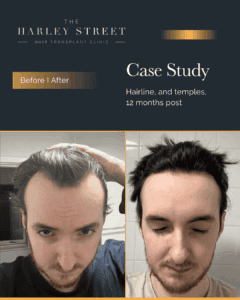
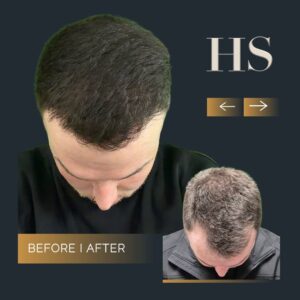
These cases show the range of hairline work, from a small temple fill to a fuller rebuild, with grafts noted for each. When you assess any before and after, look at the naturalness of the frontline, the density behind it, and whether the donor area looks untouched.

Harley Street HT pt Gerard before and after

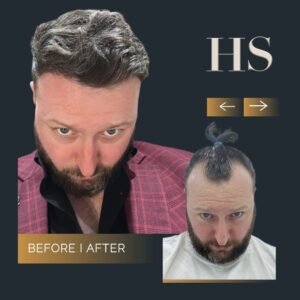
Hairline transplant before and after, advanced U-shaped recession, over 2,500 grafts. Advanced U-shaped recession. The hairline was brought forward to reduce the gap to the eyebrows. Over 2,500 grafts.

Harley Street HT Pt before and after 1

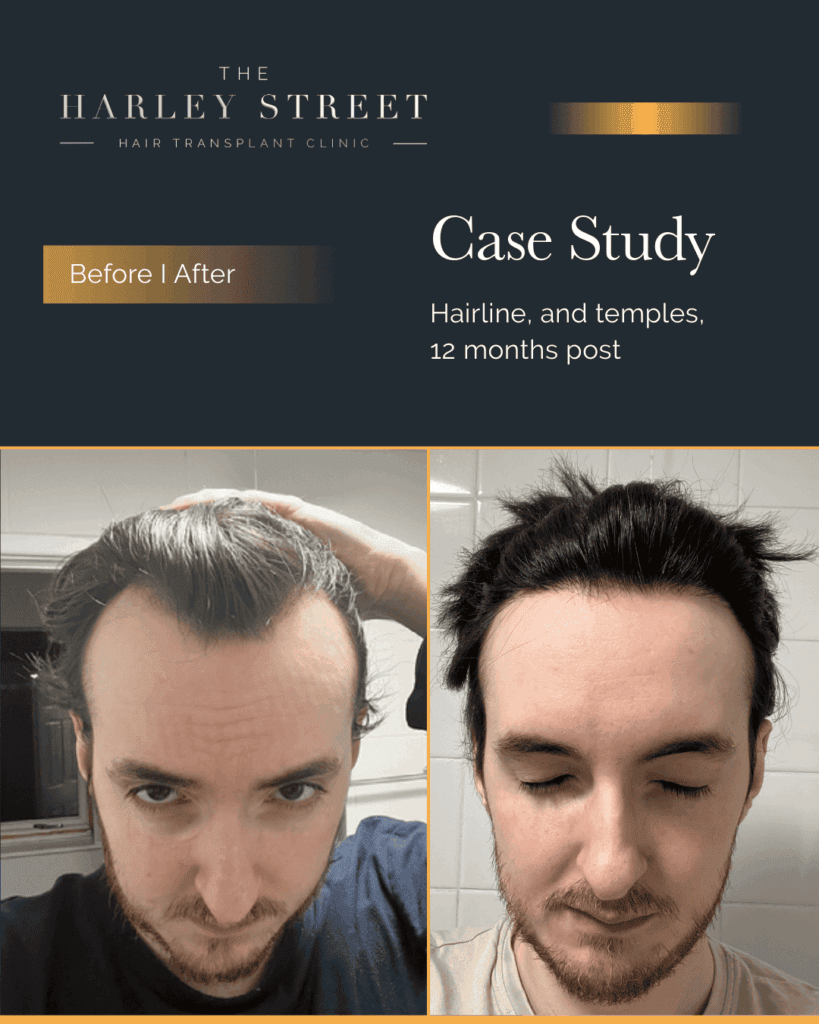
Hairline transplant before and after, temple recession, 1,800 grafts. Temple recession. Grafts rebuilt the temple corners at an acute angle to match natural growth. 1,800 grafts.

Harley Street HT Clinics pt E black

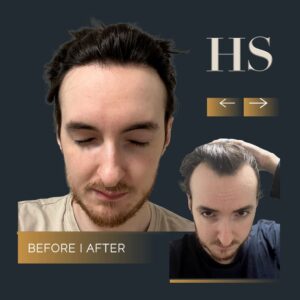
Hairline transplant before and after, early recession, 1,000 to 1,500 grafts. Early recession. A small hairless area at the front was filled with single and double-hair grafts. 1,000 to 1,500 grafts.

Our Surgeons

Our doctors are:

Our Hair Restoration Specialists

Meet our Surgeons

GMC Logo

Hairline transplant FAQs

Suitability and results

Most patients are suitable once hair loss has stabilised, often from the late twenties onward. Surgery done too early, before the pattern is settled, risks thinning appearing behind the new hairline. One of our surgeons will confirm timing against your Norwood stage at consultation.

Most hairlines need between 1,000 and 2,500 grafts. A small temple fill uses fewer, while a fuller rebuild or a lowered hairline uses more. The exact number is set after a surgeon assesses your hairline and donor supply.

A hairline transplant looks natural when it is designed with single-hair grafts along a soft, irregular frontline, placed at an acute angle with density building behind. Design, not graft count alone, is what makes the result undetectable.

Transplanted hairs shed at three to six weeks, then regrow from about month three. Some weakened native hairs nearby can also shed, called shock loss, and these usually recover. Permanent loss of grafted follicles is uncommon.

Procedure and recovery.

Yes. Transplanted follicles come from the DHT-resistant donor zone and keep that resistance, so the transplanted hairline does not recede. Native hair around it can still thin with age, which is why maintaining surrounding hair is advised.

The procedure is performed under local anaesthetic, so you are awake but feel no pain in the scalp during surgery. The anaesthetic injections sting briefly, and mild soreness during early healing is normal.

The donor and recipient areas are typically shaved so follicles can be extracted and placed precisely. Discuss shaven and minimally-shaven options with your surgeon at consultation.

Transplanted hair sheds at around three to six weeks, then regrows from about month three to four. The final hairline fills in and thickens over 9 to 12 months, though timing varies by patient.

Patient Testimonials

Aside from achieving fantastic results, we believe that keeping in touch with our patients before, during and after their hair transplantation procedure is paramount – it helps to keep our patients feeling calm and in control. We’re always on hand to provide guidance, support and aftercare advice. Time and again, our patients tell us that this is what sets us apart from other clinics.

You can read our great reviews of FUE hair transplants over on Google.

Posted on Google Google
Anthony Schettino profile picture
Anthony Schettino
03/09/2026
Google star 1Google star 2Google star 3Google star 4Google star 5Trustindex verifies that the original source of the review is Google.
My experience so far with HSHT Clinics has been excellent. Sara was my first point of contact in the initial consultation. She immediately put me at ease, explained everything in detail and was able to answer all my questions without ambiguity. After that, everything was very well organised and every appointment has been on time and useful. My surgery was performed by Dr Ditta and his team. That was also a great experience (as far as surgery goes). He was very empathetic and took my ideas and opinions into account before proceeding. The recovery was nowhere near as bad as I anticipated - essentially, I was back to normal in two weeks. It’s been 4 months since the surgery and I’ve had a few follow ups with Sara. So far, everything is looking good! Thanks again to the HSHT clinics. Highly recommend at least a consultation with them.
Posted on Google Google
Nikki profile picture
Nikki
19/07/2026
Google star 1Google star 2Google star 3Google star 4Google star 5Trustindex verifies that the original source of the review is Google.
Incredibly friendly staff, wonderful aftercare and meticulous care during the treatment. Couldn't ask for more
Posted on Google Google
anthony page profile picture
anthony page
13/07/2026
Google star 1Google star 2Google star 3Google star 4Google star 5Trustindex verifies that the original source of the review is Google.
Really happy with the service from beginning to end. Aftercare was very thorough. Very pleased with the final results. Final appearance took some time to come through, but the team kept in touch with me throughout and the follow up was very good. Would definitely recommend them.
Posted on Google Google
Stephen Healy profile picture
Stephen Healy
10/07/2026
Google star 1Google star 2Google star 3Google star 4Google star 5Trustindex verifies that the original source of the review is Google.
Had an amazing experience here during my Hair Transplant. Dr Aziz Elgindi was absolutely fantastic from the onset. A very professional surgeon who made me feel relaxed throughout the entire procedure. Could not be more happier with my results. Its only been 6 months and I have a full hairline. I have recommended this surgeon to others.
Posted on Google Google
Alex Fenn profile picture
Alex Fenn
09/07/2026
Google star 1Google star 2Google star 3Google star 4Google star 5Trustindex verifies that the original source of the review is Google.
After years of being insecure about my hairline I decided to finally take the plunge and go for a transplant. I had an initial consultation with Sara at the start of May and she was so informative, happy to answer any questions and there was no pressure to book whatsoever. The flexibility with dates was incredible and we settled on a date at the end of June. I had a series of follow up calls with the surgeon in the lead up too which was so helpful and communication was fantastic. On the day, Dr Elgindi and his team were super welcoming and lovely to be around! The procedure was comfortable and a breeze compared to what I was expecting! In terms of results, I am super happy already with the progress so far, I had minimal swelling and by 10 days all the scabs had fallen off and my new hairline looks fabulous! I am super excited to see the full results by 12 months time, and would recommend this clinic to anyone in a heartbeat.
Posted on Google Google
Joanna M profile picture
Joanna M
30/06/2026
Google star 1Google star 2Google star 3Google star 4Google star 5Trustindex verifies that the original source of the review is Google.
Harley Street Hair Transplant Clinic have been great. As a woman, my hairline has always been a sensitive topic for me, to the point I’d use a ridiculous amount of hairspray before going out to cover everything in the event of a slight breeze. I finally started looking for clinics in early 2025 but struggled to find ones in the UK with experience of making a hairline more feminine. Thankfully, an acquaintance recommended Harley Street HTC. After arranging an initial consultation, they were able to provide me with a loss of four and after photos from other women, How many of our clinics were unable to because, understandably, most of their clientele were men. I have also quite a nervous patient to say the least. However, Sara could not have been more helpful throughout the whole process. She answered all of my many questions promptly and with compassion and care. The actual transplant went as smooth as you could hope for, and the clinical team were super kind when I was nervous about them shaving the donor area. For reference I had my temples and my front hairline done in their central London clinic. During the initial two week recovery periods, they went over and above answering my many questions promptly and calming my anxieties around doing different processes correctly. Since then, they’ve checked in on me every three months for the past year, where I’ve met with Sara to discuss regrowth and upkeep. As, unlike most looking to get a hair transplant, I had quite long hair already, I’ll be honest and say that there were some periods where my overall hair did not look great due to the drastically different lengths. However, that could not be helped unless I wanted to shave my whole head and start from scratch. I am happy to report that after 12 months, my donor area is blending in perfectly with the rest of my hair. Additionally, my recipient area has seen growth of about 4 or 5 inches and is very dense and full. Although I didn’t have the widest area done, I’m still over the moon with my results. Harley Street HTC has been fantastic throughout and I couldn’t recommend them enough!
Posted on Google Google
Fung Shing Hei profile picture
Fung Shing Hei
19/05/2026
Google star 1Google star 2Google star 3Google star 4Google star 5Trustindex verifies that the original source of the review is Google.
Great experience from consultation to aftercare. Dr Ditta’s team were professional, friendly, and made me feel comfortable throughout the whole process. The clinic was clean, well organised, and the support was excellent from start to finish. Would highly recommend.
Posted on Google Google
Claire Walliker profile picture
Claire Walliker
06/05/2026
Google star 1Google star 2Google star 3Google star 4Google star 5Trustindex verifies that the original source of the review is Google.
The practitioner I spoke to gave me some great advice. The conversation was very relaxed and made me feel totally at ease. After for speaking for about 40 minutes, I was given a clear step by step process to follow to get to where I need to be. I would totally recommend anyone who is suffer hair loss a consultation with them.
Posted on Google Google
Kyle Anderson profile picture
Kyle Anderson
16/04/2026
Google star 1Google star 2Google star 3Google star 4Google star 5Trustindex verifies that the original source of the review is Google.
I had FUE treatment just under 12 weeks ago and would definitely recommend to others. The treatment was targeted to most of my front hairline and some in the crown. The procedure went smoothly and the team were clear and assuring when talking through the details. The post care instructions were thorough and the communication was kept open for any questions I had. I am happy with my results so far and look forward to further growth.
Posted on Google Google
Hollie Eagle profile picture
Hollie Eagle
01/04/2026
Google star 1Google star 2Google star 3Google star 4Google star 5Trustindex verifies that the original source of the review is Google.
Lovely staff and a fantastic service, they make sure everything is explained and that you are comfortable before the procedure. Dr Elgindi did my transplant at the Bury, Manchester clinic, brilliant job, the healing process was fine and went as explained, so I didn't have to feel worried about if it had worked. Grafts are all showing well, just waiting for the shedding, looking forward to seeing the end result and feeling confident it will look good.

Share This